
We’re bright young things, and no bright young thing
wants to squander his life as a custodian to the dead.
(from page 94)
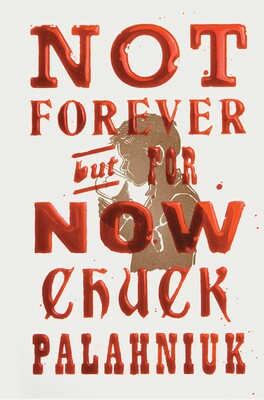
I need to put up a dartboard with adjectives and throw darts at it to choose some of my many different impressions of, _Not Forever, But For Now_ by Chuck Palahniuk. First, it is hyperbole and satire, which you will quickly discover as you read. Chuck has chosen to write in the lexicon of the UK which has an ongoing entertainment value. Not only that but he has used a litany of repeat literary devices that effectively serve to spellbind the reader.
The violent acts and thoughts are relentless to a place where the reader becomes desensitized to it. There are ongoing acts of sexual depravity that border on — no, jump both feet into — horror. Metaphor and allegory also act as suitable containers to the mayhem that permeates the story, both externally and within the heads of Otto and Cecil. Otto, the older brother, and Cecil, his passive younger brother are the two “pre-male” protagonists who think of themselves as young toddlers but who are full-grown adults who time has trapped in the world of their opulent lifestyles. Cecil is the narrator of the story, and he acts as a necessary buffer between the reader and the extreme violent and/or sexual events initiated by Otto that continue to pour forth.
As I read I couldn’t help but compare them to the depraved adventures of Mickey and Mallory in Oliver Stone’s film, “Natural Born Killers,” as the info-bytes fed to the reader bit by bit show how methodically these two characters have been assembled into the individuals they are.
I would be negligent not to mention the dark, dark humor that infuses the story. What goes on is so far beyond what any real person would experience that the effect is both flabbergasting and hilarious.
How Chuck is able create characters so depraved and deprived yet ones who somehow have managed to hold on to threads of what’s best in humans shows why he is one of the most compelling writers I’ve had the experience of reading.
Warning: as “The New York Times” blurb on the book jacket says,
Palahniuk doesn’t write for tourists…
Be prepared for anything when you open up this book.
Another blurb on the book jacket resonates for me, from “The Seattle Times,”:
… He writes at the edge of crazy, and you can feel his desperate urge to get at the truth of things.
You’ll never call this book fluff. There is a density of data that will take me some time to digest. I would expect nothing less from my hero.
I went out looking for good reviews done by others on the book and came across this one in Esquire Magazine by Jonathan Russell Clark, published 8/29/23. It gives a lot more details about the plot, doesn’t have any spoilers, and gives a lot of background information on Chuck himself that is useful to understanding the perspective that he writes from. There is even a fair amount of insight from the writer.
NEW: Interview added on 112523
 Tao-Talk
When you first was describing it my mind went to A Clockwork Orange…I don’t know why but you described some of that violence.
LikeLiked by 1 person
Max, good call, there are a *lot* of similarities between it and A Clockwork Orange, not only the violence and the sexual depravity but the lingo and repetitious phrases.
LikeLiked by 1 person
Awesome…that is what I was thinking by your description…I’m glad I came close.
LikeLiked by 1 person
I used to really enjoy Chuck’s writing. These days I’m a little queasy at some of it. He loves squishy dirty depravity a lot more than I can stomach these days.
LikeLiked by 1 person
Understandable. I feel that he writes as catharsis, and anyone who can get that stuff out has my admiration. If you can look at his writing the same way you can look at a musician’s appearance and their music, it might shift your perspective. This latest book has some of his sharpest writing to date.
LikeLiked by 1 person