You have reached a quiet bamboo grove, where you will find an eclectic mix of nature, music, writing, and other creative arts. Tao-Talk is curated by a philosophical daoist who has thrown the net away.
When God made up this world of ours, He made it long and wide, And meant that it should shelter all, And none should be denied. ~ Carrie Jacobs-Bond, from AZ Quotes
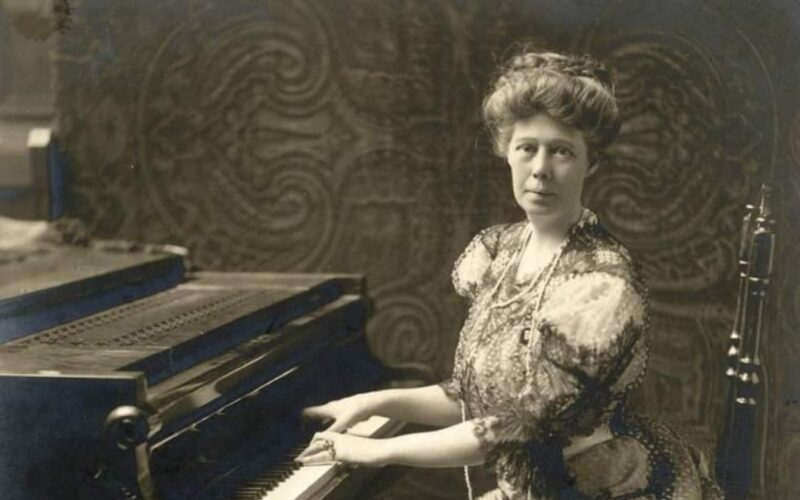
Carrie Minetta Jacobs-Bond (b. 8/11/1862 – d. 12/28/1946) was an American singer, pianist, and songwriter who composed some 175 pieces of popular music from the 1890s through the early 1940s. She is perhaps best remembered for writing the parlor song “I Love You Truly,” becoming the first woman to sell one million copies of a song. The song first appeared in her 1901 collection Seven Songs as Unpretentious as the Wild Rose, along with “Just Awearyin’ for You,” which was also widely recorded. Jacobs-Bond’s song with the highest number of sales immediately after release was “A Perfect Day” in 1910. A 2009 August 29 NPR documentary on Jacobs-Bond emphasized “I Love You Truly” together with “Just Awearyin’ for You” and “A Perfect Day” as her three great hits. Jacobs-Bond was inducted into the Songwriters Hall of Fame in 1970.
Carrie Jacobs-Bond was the most successful woman composer of her day, by some reports earning more than $1 million in royalties from her music before the end of 1910. In 1941, the General Federation of Women’s Clubs cited Jacobs-Bond for her contributions to the progress of women during the 20th century.
Early Years Carrie Minetta Jacobs was born in Janesville, Wisconsin, to Dr. Hannibal Jacobs and his wife, Mary Emogene (or Emma) Davis Jacobs and was an only child. Jacobs was born in the house of her maternal grandparents at the corner of Pleasant Street (now W. Court Street) and Oakhill Avenue. Her father died while she was a child, and the family faced financial difficulties without him.
Most of Jacobs-Bond’s family enjoyed playing music, and her father played the flute. Jacobs-Bond could pick out piano tunes at age 4, she could play some pieces just by hearing them at age 6, and then at age 8 she was able to play Liszt’s Second Hungarian Rhapsody just by hearing it. She studied the piano from age 9 to age 17, with the dream to become a songwriter. As a child, she attended classes in the Janesville public school system.
Adult Life During Jacobs’ short-lived first marriage to Edward J. Smith of Janesville, at age 18, her only child, Frederick Jacobs Smith, was born on July 23, 1882. This marriage ended in divorce in 1887. Her second marriage in 1888 was to her childhood sweetheart, physician Frank Lewis Bond of Johnstown, Wisconsin. They lived in Iron River, Michigan, where she was a homemaker and supplemented the family income with painted ceramics, piano lessons, and her musical compositions. She lived among miners and loggers for several years and when the economy of the iron mining area collapsed, Frank had no money. Struck by a child’s snowball, Dr. Bond fell on the ice, and died five days later from crushed ribs in 1895. She was left with debts too large to be covered by the $4,000 in proceeds of his life insurance, and she returned to Janesville. Selling ceramics, running a rooming house, and writing songs did not produce enough money to pay her bills. She slowly sold off their furniture and ate only once per day.
Musical Career She began writing music in the late 1880s when encouraged by her husband to “put down on paper some of the songs that were continually running through my mind.” After her return from Iron River, MI, and the death of her second husband, she took up residence at 402 East Milwaukee Street, Janesville, Wisconsin, where she wrote the song “I Love You Truly.”
After achieving some success with her composing, Jacobs-Bond moved with her son to Chicago to be closer to music publishers. For several years while living in Chicago, most of her songs never made the transition from manuscript to being published, so she had to raise money by singing them at social gatherings and concerts. Soon she found that people enjoyed her simple and lyrical music. Her lyrics and music exemplified sentimentality, which was intensely popular at that time. Since Jacobs-Bond’s attempts to have her music published were repeatedly turned down by the male-dominated music industry of the day, in 1896 she resorted to establishing her own sheet music publishing company. As a result, she was one of very few women in the industry, and perhaps the only one, to own every word of every song she wrote. Her publishing company changed location eight times, finally settling in Hollywood, CA, which is where she and her son moved to in the early 1920s to help ease the pains of her rheumatism, where she continued performing and publishing.
She named her home there “The End of the Road.” She was an early supporter of the Theatre Arts Alliance, which created the Hollywood Bowl near her home. Jacobs-Bond died in her Hollywood home of a cerebral hemorrhage on December 28, 1946, at the age of 85. She is buried in the “Court of Honor” at Forest Lawn Memorial Park Cemetery in Glendale, California.
Literature Jacobs-Bond also published books of children’s poetry and an autobiography. Her autobiography, _The Roads of Melody_ was published in 1927. She drew the artwork for her sheet music covers. The wild rose, her trademark artwork, appears on many of her publications.
Published works Sheet Music = ~160 Song books = 12 Autobiography = 1 Poetry books = 3 Short stories = 1
Kerfe, I can see that also. I found a YouTube clip of ghost hunters at her house in Michigan, now a museum. One volunteer heard her say “isn’t that nice?” as the volunteer was admiring something in the house.
Perhaps not surprisingly, I had never heard of Carrie Minetta Jacobs-Bond – what a remarkable background story and success, especially given the odds she had to overcome!
I love “I Love You Truly”….I never knew who wrote it. If she only wrote that…that would be a success! What a talented lady and a great person for supporting the arts…


 Tao-Talk
I can see a family sitting around the piano singing this together.
Thanks, once again, for giving us a glimpse into this extraordinary woman and her life. (K)
LikeLiked by 1 person
Kerfe, I can see that also. I found a YouTube clip of ghost hunters at her house in Michigan, now a museum. One volunteer heard her say “isn’t that nice?” as the volunteer was admiring something in the house.
LikeLiked by 1 person
That’s cool.
LikeLiked by 1 person
Perhaps not surprisingly, I had never heard of Carrie Minetta Jacobs-Bond – what a remarkable background story and success, especially given the odds she had to overcome!
LikeLiked by 1 person
Well-put, Christian. Every once in awhile one gets through ;)
LikeLiked by 1 person
I love “I Love You Truly”….I never knew who wrote it. If she only wrote that…that would be a success! What a talented lady and a great person for supporting the arts…
LikeLiked by 1 person
Totally agree with you!
LikeLiked by 1 person