Jiang Yuan (Chinese)

Jiang Yuan (Chinese: 姜嫄) is an important figure in Chinese mythology and history. She is recorded as having lived during ancient Chinese history. Jiang Yuan was the mother of Houji (aka Qi) who is a culture hero and revered as the god of millet and, by extension, agriculture.
Jiang Yuan’s personal name was not recorded. During the Spring and Autumn period, women were not called by personal names (名 míng) and even seemingly did not have such names, which could be considered taboo (諱 huì) to those of inferior status. Instead, Jiang is her clan name. Yuan does not seem to be a lineage name: instead, it seems to be a title signifying “origin” or “source,” in reference to her role as the mother of Qi, whom is claimed as an ancestor of the royal Ji family of the Zhou dynasty. Qi is credited in Chinese mythology with founding the Ji clan who went on to establish the Zhou dynasty.
Jiang Yuan was a consort of Emperor Ku in actual history. In mythology, she gave a virgin birth to a miracle child after she stepped into a footprint or toeprint left by the supreme deity Shangdi. As the pregnancy advanced, she felt strange and disturbed by it. She performed divinations and sacrificial rites, seeking not to have the child. In the end, she gave birth to a son. When he was first born, he was in the form of a flesh ball, which frightened Jiang Yuan. Considering him inauspicious, she abandoned him in a narrow alley. She attempted to abandon him three times (his name Qi means “the Abandoned One”) — in a narrow alley, a wild forest, and on cold ice. Each time, the infant was saved—by cattle and sheep sheltering him, by woodcutters laying down bedding, and by birds shielding him with their wings—and thus survived. Seeing these extraordinary phenomena, Jiang Yuan believed the child was under divine protection, so she took him back. After Qi grew up, Jiang Yuan taught him the techniques of cultivating mulberry and hemp, aiding his development of agricultural technology. In folk legend, she used a gold hairpin to channel floodwaters, forming the Jiang Yuan River and leaving behind the allusion of ‘Gold Hairpin Combing Water.’ Later, as the Lord of Millet, Qi set up the founding of the Zhou dynasty.
As the mother of a child from a virgin birth, Jiang Yuan mythologically became the ultimate human ancestor of the series of emperors known as the Zhou dynasty. Later generations revered her as the ‘Holy Mother’, establishing temples for worship in places like Yangling, Shaanxi. Jiang Yuan is revered not only as the mother of Qi, she benefited the people and performed great deeds.
In Chinese popular religion, Jiang Yuan is worshiped as a goddess.
Other Myths
Li Shizhen’s Ming dynasty Compendium of Materia Medica records that the medicinal herb Polygala (Yuan Zhi) was originally named “Yuan Zhi”, originating from the legend that Jiang Yuan discovered its medicinal value and used it to cure her son’s illness; the Polygala that grows around Jiang Yuan’s tomb in Shaanxi is still listed as a genuine regional medicinal material.

Real Geography
The site of Jiang Yuan’s Footprint Platform is preserved in Ling County, Xi’an. The narrow alley in the county town is traditionally said to be the place where she first abandoned her child. The Wolf’s Milk Gully on the western side of Purple Tenuity Mountain is legendary as the place where a mother wolf suckled Qi.
According to legend, in ancient times, Mount Bin (also known as Stone Gate Mountain) had rugged cliffs and ravines, streams winding around the mountain, splashing waterfalls, lush forests and grasses, and beautiful scenery. However, when heavy rainstorms occurred, mountain torrents would converge into a turbulent, roaring, earth-shaking flow. Hou Ji/Qi, who had grown up, often taught the people farming and irrigation here, but his hard work was frequently destroyed by floods. Seeing this, Jiang Yuan was deeply saddened by the loss of her son’s labor. She pulled out the gold hairpin from her hair and drew lines in the river valley, guiding the floodwaters to flow out in an orderly manner for the people’s use. This is the legendary story of Jiang Yuan’s “Gold Hairpin Combing Water.” The watercourse created by the gold hairpin became the Jiang Yuan River. For thousands of years, this river has flowed ceaselessly, irrigating happiness for generations of people.
 Jiangwan Village
95% sure this is the place
Jiang Yuan Temple
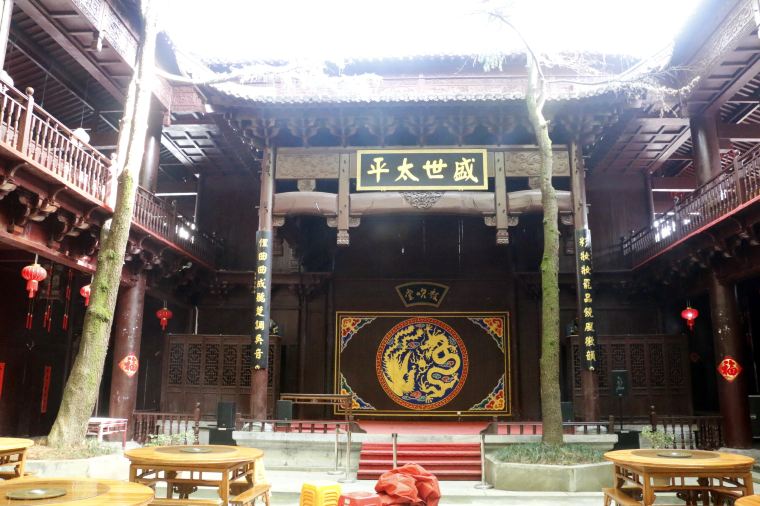
Jiang Yuan Village and Faxing Village is the site of the ancient Tai State. Jiang Yuan Temple has been destroyed and rebuilt three times, enduring many disasters. Despite that, the Temple Fair activities have hardly ceased for thousands of years. The architectural complex of this ancient temple employs a unique “phoenix nest” layout: the ancestral hall to the south of the village represents the phoenix’s head, the two wells on either side symbolize its eyes, the eastern and western Chinese honey locust trees form its wings, and the cypress grove serves as its tail. These activities continued even during the Cultural Revolution. Every year on the 23rd day of the first lunar month (Jiang Yuan’s Birthday, locally known as “Grandma Gua’s Birthday”,) villagers from surrounding villages perform lion dances, hold lively folk performances, stage grand opera, and more.
The sacrificial ceremony includes seven steps:
music
food
flowers
dance
songs
literary works
eating Filial Piety Noodles
Eating “Filial Piety Noodles” is the core ritual, originating from the legend recorded in the Fufeng County Chronicles about Qi serving noodles to his mother, symbolizing reflection on filial piety. The scale, scope, completeness of rituals, diversity of content, ancient forms, and piety of belief seen in these temple fair activities are quite rare among folk temple fairs.
The Jiang Yuan Site encompasses cultural layers from the Neolithic Period (Yangshao Culture, Longshan Culture), Western Zhou Dynasty, Eastern Zhou Dynasty, Qin, and Han periods. On 8/31/57, it was designated as a Key Cultural Relics Protection Unit of Shaanxi Province. The protection boundaries redefined in 1992 extend 50 meters east to the village entrance, 2.5 kilometers north to the Lanzhou-Lianyungang Railway, west to Yongkang Village, and 1.5 kilometers south to the Wei River. In 2011, the Jiang Yuan Temple Fair was included in the Shaanxi Provincial Intangible Cultural Heritage List.
Sources:
wikipedia
baike badu
Question: What type of geography would you like to be named after you? Why?
 Tao-Talk
I’ve lived a number of places and geological features and floral ecospheres are something to fall in love with. The glacial erratics of Michigan, the folding mountains of Appalachia, the blue bones of Texas, the mist rising out of the ground in the New Jersey Pine Barrens aquifer. But for my librarian religion, lets go with the geological feature of sedimentary rock where the layers have been pushed up to be vertical stone looking like pages, places where the goddess has placed down her books to be picked up later. They are called “Mid-Reads”. – Erin Penn
LikeLike