

The endless knot is found in Celtic and Chinese cultures and other places and is thought to have originated in Egypt.
It is drawn without the pen leaving the paper for protection.
It symbolizes something & nothing, where the rope equals matter and the space between the rope equals nothing.
It is symbolic of spirit.
It also symbolizes wisdom & compassion, male & female, night & day.
The first depiction of an endless knot is thought to have been found in the knotwork of Coptic Egypt, which remains a Christian sect (so some time after the birth of Jesus Christ.) However, upon going down the rabbit hole of research I came across an abstract for a paper that talks about the first uses of knots and links being 4500 years ago!

What’s your sign says: The Celtic knot symbol, is also referred to as the mystic knot, or the endless knot. The more esoteric or spiritual meaning of this symbol alludes to beginnings and endings. In viewing these beautiful knots, we cannot see a beginning or and end, and therefore we are reminded of the timeless nature of our spirit. This translation hearkens to our most primal selves as we contemplate the infinite cycles of birth and rebirth in both physical and ethereal realms. A less spiritual representation is also related to the knots endless nature. Due to it’s infinite path, the Celtic knot can represent an uninterrupted life cycle. Some may use this symbol as a charm of sorts – warding against sickness or setbacks that might interfere with an otherwise calm and stable life. In this vein, these knots are used as emblems, which can be found in jewelry, clothing, or home décor. In ancient times, gifts adorned with mystic knots would be given with best wishes of longevity, or luck with new endeavors.

Wikipedia says: Celtic knots (Irish: snaidhm Cheilteach, Welsh: cwlwm Celtaidd) are a variety of knots and stylized graphical representations of knots used for decoration, used extensively in the Celtic style of Insular art. These knots are most known for their adaptation for use in the ornamentation of Christian monuments and manuscripts, such as the 8th-century St. Teilo Gospels, the Book of Kells and the Lindisfarne Gospels. Most are endless knots, and many are varieties of basket weave knots.

From the Book of Kells
Tibetan Buddhism believes the endless knot or eternal knot (Sanskrit: śrīvatsa; Tibetan དཔལ་བེའུ། dpal be’u; Mongolian Улзии) is a symbolic knot and one of the Eight Auspicious Symbols. It is in important symbol in both Jainism and Buddhism. It is an important cultural marker in places significantly influenced by Tibetan Buddhism such as Tibet, Mongolia, Tuva, Kalmykia, and Buryatia. It is also sometimes found in Chinese art and used in Chinese knots.
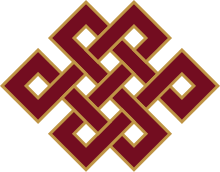
In Jainism it is one of the eight auspicious items, an asthamangala, however it is found only in the Svetambara sect. It is often found marking the chests of the 24 Saints, the tirthankaras. It is more commonly referred to as the Shrivatsa.

The endless knot has been described as “an ancient symbol representing the interweaving of the Spiritual path, the flowing of Time and Movement within That Which is Eternal. All existence, it says, is bound by time and change, yet ultimately rests serenely within the Divine and the Eternal.”[3] Various interpretations of the symbol are:
- The eternal continuum of mind.
- The endless knot iconography symbolised Samsara i.e., the endless cycle of suffering or birth, death and rebirth within Tibetan Buddhism.
- The inter-twining of wisdom and compassion.
- Interplay and interaction of the opposing forces in the dualistic world of manifestation, leading to their union, and ultimately to harmony in the universe.
- The mutual dependence of religious doctrine and secular affairs.
- The union of wisdom and method.
- The inseparability of emptiness (shunyata) and dependent origination, the underlying reality of existence.
- Symbolic of knot symbolism in linking ancestors and omnipresence (refer to etymology of Tantra, Yoga and religion)
- Since the knot has no beginning or end it also symbolizes the wisdom of the Buddha.

At Norse Mythology for Smart People, In the archaeological record, the Valknut appears only in connection with the cult of the dead, as in …runestones and ship burial. Similar-looking symbols can also be found on the cremation urns of the Anglo-Saxons, another Germanic people closely related to the Norse linguistically, ethnically, and in terms of their pre-Christian worldview and religion.

The Valknut on the Stora Hammars I stone, Gotland, Sweden
It would take a lot of research to even begin to develop a chronology on when each of these were used, if the symbols arose spontaneously, or if trade made sharing of ideas possible. What you can see is that the endless knot is found all across the globe!
 Tao-Talk


Jade,
I received a bit of education on the endless knot. Other than its name I sorta grasp its meaning of no beginning; no end but all the in-between I found intriguing. I like endless knot designs on quilts and would love to have one someday.
Join me today for a look at myA2Z The Little Mermaid art sketch ‘Eric’. Happy a2zing!
LikeLiked by 1 person
It is a design that is everywhere and a quilt with it would probably give you good dreams if you slept under it. There are how-to videos for at least drawing them on youtube. I will check out Eric.
LikeLike
Do you think that the Gordian Knot was an endless knot?
LikeLiked by 1 person
Is this a riddle? I think it is, but an endlessly snarled one. With the Celtic and other endless knots it looks like it would be easy to straighten them out, but the Gordian not so. Funny I didn’t see that anywhere in my research. Is it more of a metaphor? I did just go out to google and see graphics of it, but…
LikeLiked by 1 person
I love Celtic knots (maybe it has something to do with having spent over 8 years in Ireland?), but I didn’t know Chinese and Egyptians also had them. :O
they are so hard to draw: to make the lines perfect, to ensure the crossings go up and down correctly… Some month ago I tried to draw a dragonfly that was a Celtic knot and it took me ages to finish it. But the result, if I may say so myself, was quite nice.
LikeLiked by 1 person
Yes, I can imagine they are hard to draw. I started to watch a youtube last night that shows in detail how to do it. I got halfway through before saying not tonight :)
LikeLiked by 1 person
Did you succeed the next day, though? :)
LikeLiked by 1 person
I never went back to it, darn it. I know where it’s at though!
LikeLiked by 1 person
I really like the thoughts about the endless knots, and their being for good. They are all so pretty, too. :)
LikeLiked by 1 person
Thanks Barbara! Yes they are :)
LikeLiked by 1 person