
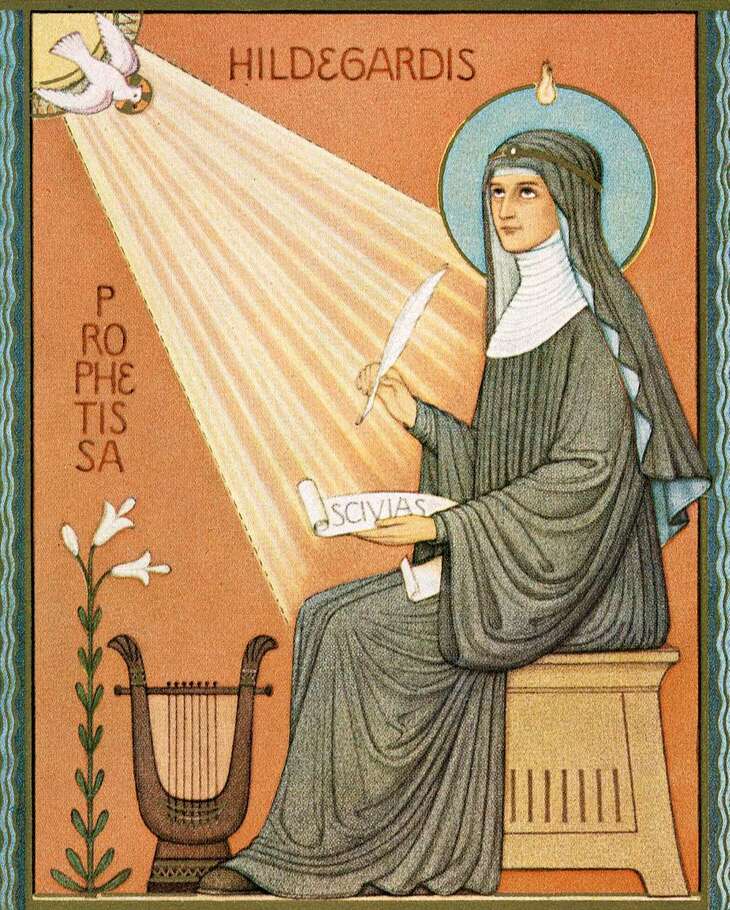
From my early childhood, before my bones, nerves, and veins were fully strengthened, I have always seen this vision in my soul, even to the present time when I am more than seventy years old. In this vision, my soul, as God would have it, rises up high into the vault of heaven and into the changing sky and spreads itself out among different peoples, although they are far away from me in distant lands and places. And because I see them this way in my soul, I observe them in accord with the shifting of clouds and other created things. I do not hear them with my outward ears, nor do I perceive them by the thoughts of my own heart or by any combination of my five senses, but in my soul alone, while my outward eyes are open.
–from Hildegard’s letter to Guibert of Gembloux, which she wrote at the age of 77
Hildegard of Bingen (b.~ 1098 – d. 9/17/1179,) also known as Saint Hildegard and the Sibyl of the Rhine, was a German Benedictine abbess and polymath active as a writer, composer, philosopher, mystic, visionary, and as a medical writer and practitioner during the High Middle Ages. She is one of the best-known composers of sacred monophony, as well as the most recorded in modern history. She has been considered by a number of scholars to be the founder of scientific natural history in Germany. Hildegard is also known as the first “identifiable” female songwriter.
Early Life:
Hildegard’s parents were Mechtild of Merxheim-Nahet and Hildebert of Bermersheim, a family of the free lower nobility in the service of the Count Meginhard of Sponheim. Sickly from birth, Hildegard is traditionally considered their youngest and tenth child, although there are records of only seven older siblings. In her Vita, Hildegard states that from a very young age she experienced visions.
Somewhere between the ages of 8 to 14, perhaps because of Hildegard’s visions or as a method of political positioning, or both, Hildegard’s parents offered her as an oblate to the Benedictine monastery at Disibodenberg, which had been recently reformed in the Palatinate Forest.
Musical Beginnings:
In the monastery she learned to play the psaltery, a prototype of the zither. She also learned simple psalm musical notation there. At around the age of 40, when she was struck down with a mysterious illness, the power structure granted her and the nuns under her their own abbey, which I’m guessing gave her the freedom to develop her natural abilities.
Discography:
Attention in recent decades to women of the medieval Catholic Church has led to a great deal of popular interest in Hildegard’s music.
One of her better-known works, Ordo Virtutum (Play of the Virtues), is a morality play. It is uncertain when some of Hildegard’s compositions were composed, though the Ordo Virtutum is thought to have been composed as early as 1151. It is an independent Latin morality play with music (82 songs); it does not supplement or pay homage to the Mass or the Office of a certain feast. It is, in fact, the earliest known surviving musical drama that is not attached to a liturgy.
In addition to the Ordo Virtutum, 69 musical compositions, each with its own original poetic text, survive, and at least four other texts are known, though their musical notation has been lost. This is one of the largest repertoires among medieval composers.
Her music is monophonic, consisting of exactly one melodic line. Its style has been said to be characterized by soaring melodies that can push the boundaries of traditional Gregorian chant and to stand outside the normal practices of monophonic monastic chant. Another feature of Hildegard’s music that both reflects the 12th-century evolution of chant, and pushes that evolution further, is that it is highly melismatic, defined by wiki as, “the singing of a single syllable of text while moving between several different notes in succession. Music sung in this style is referred to as melismatic, as opposed to syllabic, in which each syllable of text is matched to a single note. An informal term for melisma is a vocal run.” It also often ran with recurrent melodic units.
Some things to share:
Hildegard also invented an alternative alphabet that some believed was a way to develop solidarity with the nuns at her abbey. I imagine a female with power at that time and place in history would find an alternate alphabet with which to communicate very useful, not to mention protective.
Official website: It’s funny to think that Hildegard would have her own website. There is a wealth of information to be found on this amazing individual out there.
Source: wikipedia
 Tao-Talk
A great bit of history and a well told story about a brilliant woman songwriter and so much more.I only mentioned her by name on a post I did last March but I knew little about her. Good stuff Lisa.
LikeLiked by 1 person
Thanks, Randy. I learned so much while picking and choosing what to include. She’s an impressive historical figure. I recognize that singing from Loreena McKennitt. I knew her style was special but not where it came from. I watched quite a few videos before deciding on the one I did. The presentations went from ultra-pretentious to stripped of ostentation. Neither one seemed to fit. I went with one where the listener can pay attention to what’s being said in the lyrics.
LikeLiked by 1 person
Well curated
LikeLiked by 1 person
Wow, Lisa, thanks for the German history lesson. I literally knew zero about anything you wrote in your post. It appears Hildegard of Bingen wasn’t unhappy about her situation. That said, I know the practice of putting young women who “were deemed useless” into a monastery, oftentimes against their will, persisted long beyond the middle ages in Germany.
LikeLiked by 1 person
You’re welcome, Christian. It was all new info to me as well. I ran across her and some other ancient names somewhere and added them to my future WMM list and here she is. Oh I imagine there are all kinds of definitions of “deemed useless” floating around, and in male-dominated and controlled places, how better to keep the docility of the females than to lock the “useless” ones up and away. I think asylums have also served that function. Thanks for adding to the history aspects.
LikeLiked by 1 person
I’ve just been reading about the Benedictines. It makes sense that she would thrive in that atmosphere. The Psalms are very important to them, and evidently they sing them every day.
Music transcends both time and place. (K)
LikeLiked by 1 person
Wow, that’s cool, Kerfe. You’re right, music is like a time machine. I could see myself in a place like that (without the man-made image of god part.) It seems that Hildegard had a different vision of a higher power.
LikeLiked by 1 person
God is a big stumbling block for me. But there is a lot to be said for a life devoted to spirit.
LikeLiked by 1 person
It’s funny, one of the women I work with is named Mechthild, like Hildegard’s mother.
I love this type of music and kudos to her for being so prolific (I bet she never would have been able had she not be “gifted” to the monastery. Kudos to you for sharing her with us. Vielen dank!
LikeLiked by 1 person
So happy you enjoyed the post and the music. You’re right, like I said in my story, “there are no mistakes.” But why the *hell* must we suffer so much to get where we need to be? What does “Vielen dank” mean?
LikeLiked by 1 person
I did! And it is so frustrating to have to suffer, dammit!
And I was showing off my German. It means thank you very much. :)
LikeLiked by 1 person
Dale, you speak French, English, *and* German?? How many other languages??
LikeLiked by 1 person
Well… not so much speak as know a phrase or two in Spanish, Italian, German; can count to ten in Japanese (thank you karate)… say good night in 7 ;-)
LikeLiked by 1 person
8o <– read sideways
LikeLiked by 1 person
😉
LikeLiked by 1 person
A new artist for me, I shall check her out more! I enjoyed this Li :-)
LikeLiked by 1 person
Goody :)
LikeLike