You have reached a quiet bamboo grove, where you will find an eclectic mix of nature, music, writing, and other creative arts. Tao-Talk is curated by a philosophical daoist who has thrown the net away.
Amy Marcy Cheney Beach (b. 9/5/1867 – d. 12/27/1944) was an American composer and pianist. She was the first successful American female composer of large-scale art music.
Early years and Musical Education She was born in Henniker, New Hampshire to Charles Abbott Cheney and Clara Imogene (Marcy) Cheney. Artistic ability ran in the family: Clara was reputedly an “excellent pianist and singer,” while Amy showed every sign of being a child prodigy. She was able to sing 40 songs accurately by age 1, she was capable of improvising counter-melody by age 2, and she taught herself to read at age 3. At 4, she composed three waltzes for piano during one summer at her grandfather’s farm in West Henniker, NH, despite the absence of a piano; instead, she composed the pieces mentally and played them when she returned home. She could also play music by ear, including 4-part hymns. The family struggled to keep up with her musical interests and demands.
Amy began formal piano lessons with her mother at age 6, and soon gave public recitals of works by Handel, Beethoven, and Chopin, as well as her own pieces.
In 1875, the Cheney family moved to Chelsea. They were advised there to enroll Amy in a European conservatory, but opted instead for local training. In 1881–82, the 14-year-old also studied harmony and counterpoint with Junius W. Hill. This would be her only formal instruction as a composer, but she collected every book she could find on theory, composition, and orchestration. She taught herself.
Early Career Amy Cheney made her concert debut at age 16 on 10/18/1883, in a “Promenade Concert.” A biographer commented, “[i]t is hard to imagine a more positive critical reaction to a debut,” and her audience was “enthusiastic in the extreme.” The next 2 years of her career included performances in Chickering Hall and with the Boston Symphony.
Marriage Beach was married in 1885 to Dr. Henry Harris Aubrey Beach, a Boston surgeon, Harvard lecturer, and amateur singer twenty-four years her senior (she was 18 at the time.) The marriage was conditioned upon her willingness “to live according to his status, that is, function as a society matron and patron of the arts. She agreed never to teach piano, an activity widely associated with women” and regarded as providing “pin money.” She further agreed to limit performances to 2 public recitals per year, with profits donated to charity, and to devote herself more to composition than to performance (although, as she wrote, “I thought I was a pianist first and foremost.“) Her self-guided education in composition was also necessitated by Dr. Beach, who may have disapproved of his wife studying with a tutor. Restrictions like these were typical for middle- and upper-class women of the time: as it was explained to a European counterpart, Fanny Mendelssohn, “Music will perhaps become his [Fanny’s brother Felix Mendelssohn’s] profession, while for you it can and must be only an ornament.”
In recollecting her married life in 1942, Beach stated, “I was happy and he was content” and “I belonged to a happy period that may never come again.”
A major compositional success came with her Mass in E-flat major, which was performed in 1892 by the Handel and Haydn Society orchestra, which since its foundation in 1815 had never performed a piece composed by a woman. Beach followed this up with an important milestone in music history: her Gaelic Symphony, the first symphony composed and published by an American woman. It premiered October 30, 1896, performed by the Boston Symphony. In 1900, the Boston Symphony premiered Beach’s Piano Concerto, with the composer as soloist.
Widowhood, years in Europe Beach’s husband died in June 1910 (the couple had been childless) and her mother 7 months later. Her father had died in 1895. She felt unable to work for a while. She went to Europe in hopes of recovering there. In Europe she changed her name to “Amy Beach” and traveled together with Marcella (Marcia) Craft, an American soprano who was “prima dona of the Berlin Royal Opera.” In 1912 she gradually resumed giving concerts and continued in Germany until her return to America in 1914.
Return to America In 1916, she, her Aunt Franc, and Cousin Ethel took up residence in Hillsborough, New Hampshire, where Franc and Beach’s mother had been born. Beach also spent part of her time in New York City. For a few summers, she composed at her cottage in Centerville, Massachusetts on Cape Cod. She continued to get income from her compositions. The Centerville cottage had been built on a five-acre property Beach had bought with royalties from one song, Ecstasy, 1892, her most successful composition up until then.
From 1921 on, she spent part of each summer as a Fellow at the MacDowell Colony in Peterborough, New Hampshire, where she composed several works and encountered other women composers and/or musicians, including Emilie Frances Bauer, Marion Bauer, Mabel Wheeler Daniels, Fannie Charles Dillon, and Ethel Glenn Hier, who “were or became long-time friends” of Beach.
In the fall of 1930, after the death of her Aunt and Cousin, she rented a studio apartment in New York and became the virtual composer-in-residence at St. Bartholomew’s Episcopal Church, where her music had been used during the previous 20 years in services there.
While she had agreed not to give private music lessons while married, Beach was able to work as a music educator during the early 20th century. She served as President of the Board of Councillors of the New England Conservatory of Music. Given her status and advocacy for music education, she was in high demand as a speaker and performer for various educational institutions and clubs. She also worked to create “Beach Clubs,” which helped teach and educate children in music.
Retirement and Passing Heart disease led to Beach’s retirement in 1940, around the time of which she was honored at a testimonial dinner by 200 of her friends in New York. Beach died in New York City in 1944. Amy Beach is buried with her husband in the Forest Hills Cemetery in the Jamaica Plain neighborhood of Boston, Massachusetts.
I could try to list the number of Amy’s compositions, but it would take a very long time. Instead, if you want to see the list, go HERE.
Writings Beach was a musical intellectual who wrote for journals, newspapers, and other publications. She gave advice to young musicians and composers – especially female composers. From career to piano technique advice, Beach readily provided her opinions in articles such as “To the Girl who Wants to Compose” and “Emotion Versus Intellect in Music.” In 1915, she had written Music’s Ten Commandments as Given for Young Composers, which expressed many of her self-teaching principles.
Revival Despite her fame and recognition during her lifetime, Beach was largely neglected after her death in 1944 until the late 20th century. Efforts to revive interest in Beach’s works have been largely successful during the last few decades.
I think it’s perhaps a blessing she was able to live a large part of her life without her husband’s expectations (even though she claimed to be happy). What an amazing talent. I’m glad her music is being revived and she is being given proper recognition. (K)
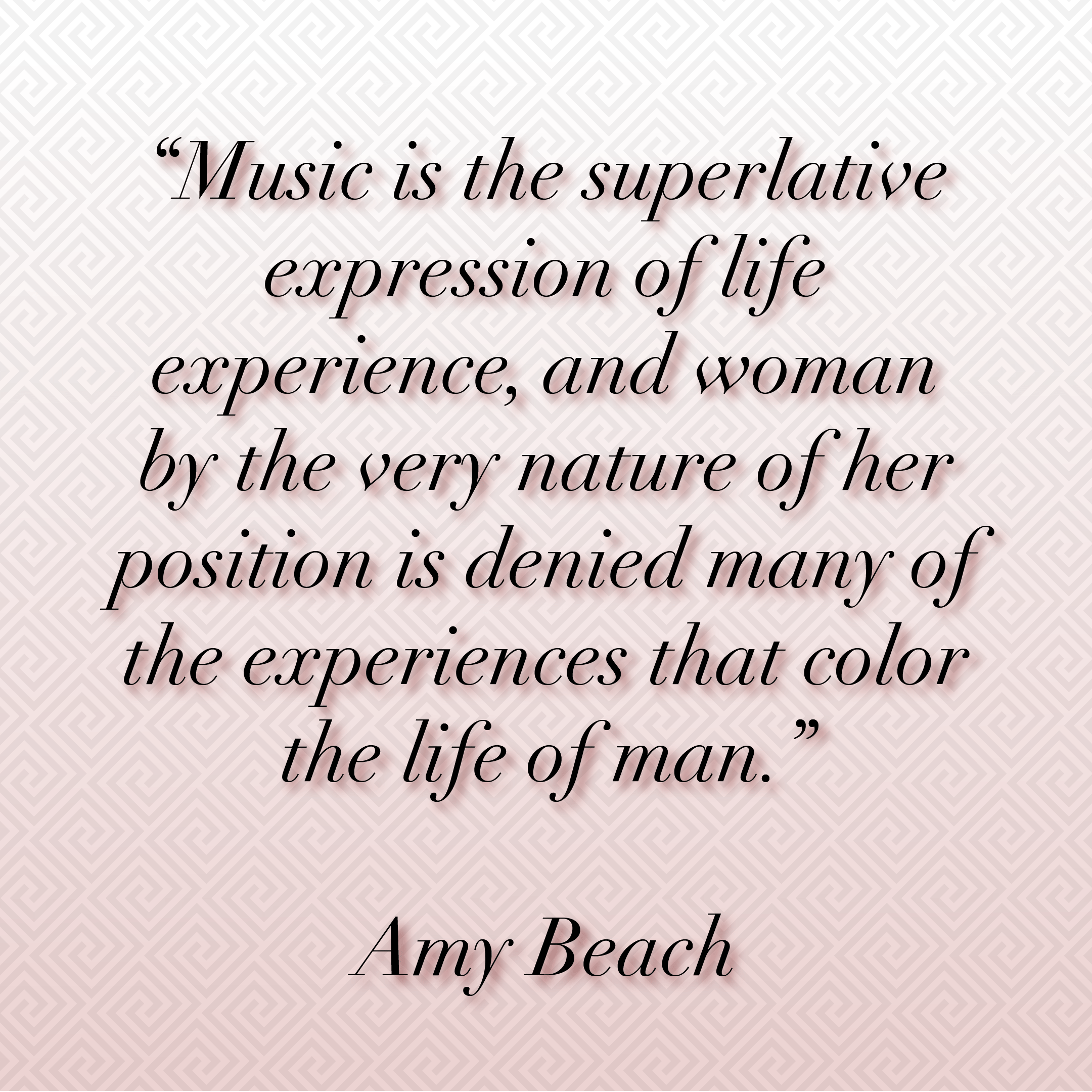
The quote at the top of your post seems like it could be a calling card for this series, Lisa. Beach’s story shows she certainly had to bear the burden of misogyny in the harsh limitations placed up on her, as if she were property. Nevertheless, she persisted, as the saying goes. I’m only familiar with Beach’s work through the “Romance” you featured, as I encountered that recording last year when searching for classical pieces for my Sunday feature. “Dreaming” was new to me; very beautiful, the conversation between the cello and piano.
It’s tragic Beach’s life was cut short, and unconscionable that our male-dominated society constrained her limitless potential for artistry. I’m glad to know she continued, and that her work has seen a revival. We humans are slow learners (well, about half, anyway). Thank you for sharing another truly remarkable woman in music, Lisa.
Steve, you are so right about her quote being a calling card for Women Music March. Trying to find quotes by some of the older ones has been tough and this may have been the only quote of hers I could find iirc (other than saying she was happily married.) You are welcome on sharing these marvelous music makers.
Thanks for taking on this topic — very appropriate! I need to go back and go through all of these. Until Nadia Boulanger came along, women just weren’t allowed to be composers, and even she was forced to deal with imposed limitations. But thanks to her, women composers became more and more prevalent in all genres.
I sometimes reflect on how great Fanny Mendelssohn would have been if she had been given the same opportunities of her brother, or home many woman composers would have been equals to the currently well known names from post-Hildegard to pre-Boulanger if they had not been institutionally marginalized.
Aaron Copland was a resident/guest composer for one week at my college in the 1970s — he studied with Nadia Boulanger, as did Virgil Thompson who also spent a week at a resident composer. Roy Harris (who was close by at UCLA) also had studied with her.
Looking forward to your remaining artists. Guessing they might include Billie Holiday and Joni Mitchell.
Someone I have mentioned in my blog by way of reference only. So it was quite interesting to learn a bit more about her. She really is one of the most prominent early examples of women who somehow managed to circumvent the harsh obstacles faced by women in music.



 Tao-Talk

Such pleasant music, Lisa.
LikeLiked by 1 person
Jim, totally agree.
LikeLiked by 1 person
I love when people teach as well…especially to children. Very nice music…
LikeLiked by 1 person
Max, she was an amazing person, and her music makes her immortal. Glad you like the music.
LikeLiked by 1 person
Thank you for sharing Amy Beach’s life. So talented and gifted. What gorgeous music, Li!!❣️
LikeLiked by 1 person
My pleasure, Cindy <3
LikeLiked by 1 person
❤️❤️❤️
LikeLiked by 1 person
<3
LikeLike
I think it’s perhaps a blessing she was able to live a large part of her life without her husband’s expectations (even though she claimed to be happy). What an amazing talent. I’m glad her music is being revived and she is being given proper recognition. (K)
LikeLiked by 1 person
And I especially like that second video.
LikeLiked by 1 person
K, I would have to agree with you on the hub’s expectations. She was amazing. I appreciate the people who are excavating for women music out there.
LikeLiked by 1 person
Yes me too.
LikeLiked by 1 person
The quote at the top of your post seems like it could be a calling card for this series, Lisa. Beach’s story shows she certainly had to bear the burden of misogyny in the harsh limitations placed up on her, as if she were property. Nevertheless, she persisted, as the saying goes. I’m only familiar with Beach’s work through the “Romance” you featured, as I encountered that recording last year when searching for classical pieces for my Sunday feature. “Dreaming” was new to me; very beautiful, the conversation between the cello and piano.
It’s tragic Beach’s life was cut short, and unconscionable that our male-dominated society constrained her limitless potential for artistry. I’m glad to know she continued, and that her work has seen a revival. We humans are slow learners (well, about half, anyway). Thank you for sharing another truly remarkable woman in music, Lisa.
LikeLiked by 1 person
Steve, you are so right about her quote being a calling card for Women Music March. Trying to find quotes by some of the older ones has been tough and this may have been the only quote of hers I could find iirc (other than saying she was happily married.) You are welcome on sharing these marvelous music makers.
LikeLiked by 1 person
Thanks for taking on this topic — very appropriate! I need to go back and go through all of these. Until Nadia Boulanger came along, women just weren’t allowed to be composers, and even she was forced to deal with imposed limitations. But thanks to her, women composers became more and more prevalent in all genres.
I sometimes reflect on how great Fanny Mendelssohn would have been if she had been given the same opportunities of her brother, or home many woman composers would have been equals to the currently well known names from post-Hildegard to pre-Boulanger if they had not been institutionally marginalized.
LikeLiked by 1 person
Walt, thanks for the info. I have added Nadia Boulanger to my list for a future WMM.
LikeLiked by 1 person
Aaron Copland was a resident/guest composer for one week at my college in the 1970s — he studied with Nadia Boulanger, as did Virgil Thompson who also spent a week at a resident composer. Roy Harris (who was close by at UCLA) also had studied with her.
Looking forward to your remaining artists. Guessing they might include Billie Holiday and Joni Mitchell.
LikeLiked by 1 person
Very awesome to get that close to the greats, Walt. I’ve covered Billie and Joni in previous years :)
LikeLike
Someone I have mentioned in my blog by way of reference only. So it was quite interesting to learn a bit more about her. She really is one of the most prominent early examples of women who somehow managed to circumvent the harsh obstacles faced by women in music.
LikeLiked by 1 person
Randy, glad you were aware of her existence. Every once in awhile one gets through. Thank you for reading, listening, and commenting.
LikeLiked by 1 person
she is so talented, anyone who starts playing music at a young age usually is!
LikeLiked by 1 person
:)
LikeLike