Bast (Egyptian)
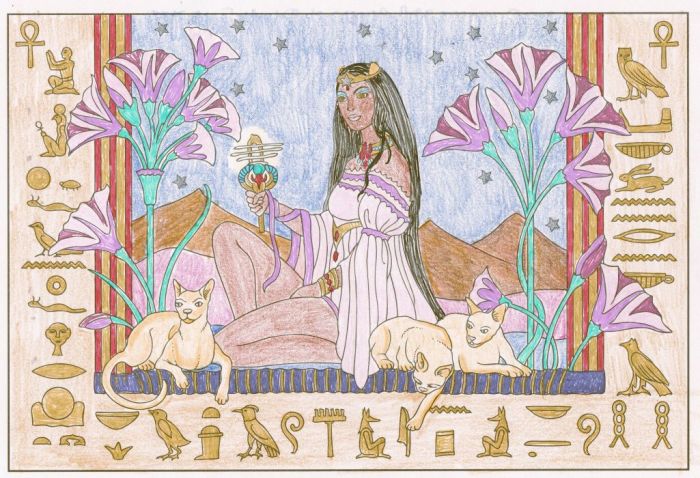
Bast (aka Bastet) was one of the most popular goddesses of ancient Egypt. She is generally thought of as a cat goddess. However, she originally had the head of a lion or a desert sand-cat and it was not until the New Kingdom that she became exclusively associated with the domesticated cat. Even then, she remained true to her origins and retained her war-like aspect.
Bast personified the playfulness, grace, affection, and cunning of a cat, as well as the fierce power of a lioness. She was also worshiped all over Lower Egypt, but her cult was centered on her temple at Bubastis, which was the capital of ancient Egypt for a time.
She was thought to be the mother of Nefertum (who was a god of perfume,) which some say implies that she is sweet and precious, but that under the surface lay the heart of a predator. She occasionally bears a was-scepter (signifying strength) and is often accompanied by a litter of kittens.
Cats were sacred to Bast, and to harm one was considered to be a crime against her and so very unlucky. Her priests kept sacred cats in her temple, which were considered to be incarnations of the goddess. When they died they were mummified and could be presented to the goddess as an offering. The ancient Egyptians placed great value on cats because they protected the crops and slowed the spread of disease by killing vermin. As a result, Bast was seen as a protective goddess. Evidence from tomb paintings suggests that the Egyptians hunted with their cats and also kept them as beloved pets, which may have contributed to Bast’s popularity.
As the daughter of Ra she was one of the goddesses known as the “Eye of Ra,” a fierce protector who almost destroyed mankind but was tricked with blood-colored beer which put her to sleep and gave her a hangover, stopping the carnage. Bast is most notably close to another “Eye of Ra,” Sekhmet. During the Feast of Hathor, an image of Sekhmet represented Upper Egypt while an image of Bast represented Lower Egypt. Bast was very closely linked to Hathor. She was often depicted holding a sistrum (the sacred rattle of Hathor) and Denderah (the home of the cult centre of Hathor in the sixth nome of Upper Egypt) was sometimes known as the “Southern Bubastis”.
Source: Ancient Egypt Online Ukhttps://ancientegyptonline.co.uk/bast/

Bast image created by Gunawan Kartapranata
Festival of Bast
Herodotus relates that of the many solemn festivals held in Egypt, the most important and most popular one was that celebrated in Bubastis in honor of Bast. Each year on the day of her festival, the town was said to have attracted some 700,000 visitors, both men and women (but not children,) who arrived in numerous crowded ships. The women engaged in music, song, and dance on their way to the place. Great sacrifices were made and prodigious amounts of wine were drunk—more than was the case throughout the year. This accords well with Egyptian sources which prescribe that lioness goddesses are to be appeased with the “feasts of drunkenness.”
Source: wikipedia
Question: If you were a goddess, what would you like your festival to look like?
 Tao-Talk
super interesting Li 📔🙌💜💜
LikeLike
❤️
LikeLike