Mahu/Mawu (West Africa)
Note: While researching for information on Mahu, I learned that this entry should be about the Mother of Mawu-Lisa, Nana Buluku, who is described as what I’ve come to call The Mysterious Mother from my studies of Daoism. That said, I’m keeping the entry the way it is.
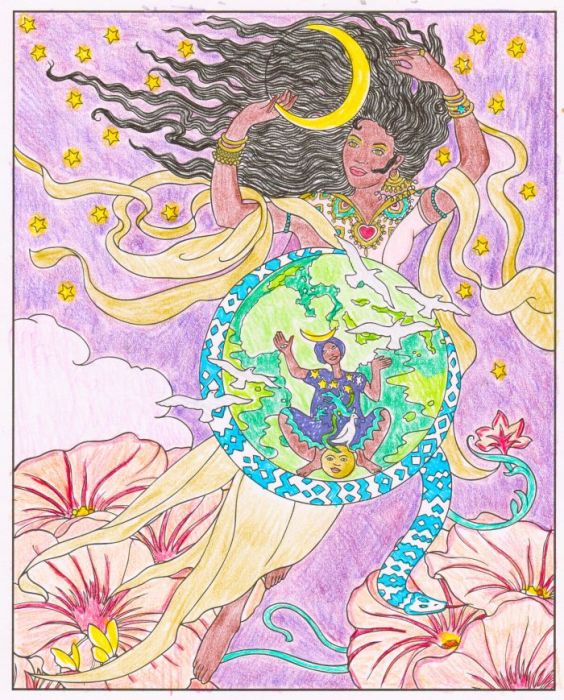
Mawu, the celestial mother goddess of the Fon people of Dahomey (modern-day Benin,) is one of the most revered and powerful figures in West African mythology. As a goddess of creation, wisdom, and compassion, she embodies the nurturing and protective aspects of the divine. She is often paired with her twin and consort, Lisa, forming a cosmic duality that represents the balance between opposites—night and day, moon and sun, rest and work, feminine and masculine. Together, Mawu-Lisa is the supreme deity of the Dahomey pantheon, governing the universe in harmony. However, while Lisa is associated with the sun, heat, and labor, Mawu is deeply tied to the moon, coolness, and renewal, making her the gentler and more maternal force in their sacred union.
According to Dahomean mythology, Mawu and Lisa were born from Nana Buluku, the primordial deity who created the universe. Recognizing that creation required both order and sustenance, Nana Buluku divided their divine essence into two complementary beings—Mawu, the goddess of night and fertility, and Lisa, the god of day and strength. Mawu, with her luminous presence, brought forth life, infusing the world with beauty, abundance, and wisdom. She shaped the earth with a tender hand, filling the land with lush vegetation and blessing humanity with the gift of creativity. While Lisa represented the energy of action and the fire of the sun, Mawu ensured that life flourished, overseeing the cycles of nature and providing the coolness of the night, allowing for restoration and peace.
Mawu’s themes are creativity, Universal Law, passion, abundance, birth, and inspiration. Her symbols are clay and the moon. Mawu arrives on an elephant’s back, expectant with spring’s creative energy. Hers is a wise passion and a timely birth, being ruled by natural laws and universal order. In Africa, She is a lunar-aligned creatrix who made people from clay. As a mother figure, Mawu inspires the universe’s abundance and every dreamers imagination.
One creation myth:
After creating the earth and all life and everything else on it, Mawu became concerned that it might be too heavy, so She asked the primeval serpent, Aido Hwedo, to curl up beneath the earth and thrust it up in the sky. When She asked Awe, a monkey She had also created, to help out and make some more animals out of clay, he boasted to the other animals and challenged Mawu. Gbadu, the first woman Mawu had created, saw all the chaos on earth and told her children to go out among the people and remind them that only Mawu can give Sekpoli – the breath of life. Gbadu instructed her daughter, Minona, to go out among the people and teach them about the use of palm kernels as omens from Mawu. When Awe, the arrogant monkey climbed up to the heavens to try to show Mawu that he too could give life, he failed miserably. Mawu made him a bowl of porridge with the seed of death in it and reminded him that only She could give life and that She could also take it away.
African deities are generally grouped as primary deities, secondary deities, and tertiary deities, the latter group including clan spirits, local divinities, and personal gods.
In the Dahomean Vodun pantheon, Mawu-Lisa (also spelled Mahu-Lisa, Mahou-Lissa, or Mahu-Lissa) is the first on the list of primary deities. In other words, in the hierarchy of powers, Mawu-Lisa comes at the top and assumes the role of commander-in-chief. In his role as the patron saint of the universe and all things and creatures in it, Mawu-Lisa is surrounded by his children or creatures, that is, all Vodun who serve as intermediaries or emissaries between human beings and him.
The concept of Mawu-Lisa may be difficult to comprehend in the sense that when Mawu and Lisa are seen separately, which they occasionally are, it is only Lisa who becomes a separate deity that is worshiped. Like all other Vodun, Lisa has shrines, priests, and priestesses, as well as rituals dedicated to him. Thus, the adepts of Lisa are known as Lisassi (wives of Lisa.) Conversely, there is no separate Vodun called Mawu, who is worshiped and has shrines, priests and priestesses, and rituals dedicated to her.
Going back to how Mawu and Lisa were created, it would seem that neither would be separately worshiped, as it is the balancing between the two where the ideal in life thrives.
Question: If you could choose between
being Nana Buluku, Mawu, Lisa, or Mawu-Lisa,
which one would you choose to be and why?
Sources:
Journeying into the Goddess
The Paganista
Atlas Mythica


Since I’m already a “nana,” I’ll stick with that! Then I can live part time with my sun child and part time with my moon child 😀
LikeLiked by 2 people
Very cool, and makes perfect balance, Paula.
LikeLiked by 1 person
Likely Mawu-Lisa, the concept of “father-mother-god all harmonious” is one I grew up with, so man AND woman in one being makes sense to me, them being both separate and the same. The truth is humanity is both at the same time and unless we accept the commune of gender-divinity, we are missing part of ourselves. – Erin Penn
LikeLiked by 2 people
Erin, in a dream group I’m a part of, our leader/facilitator talks about Jung and his idea of anima and animus and tries to reconcile just what you say. I totally agree that we have to acknowledge both within ourselves.
LikeLiked by 1 person
Since I’m a Lisa, and she “… represented the energy of action and the fire of the sun,” and I’m a Leo, ruled by the sun (although I’ve always thought I was a poor example of a Leo, more a closet Leo), I’d have to go with Lisa!
LikeLiked by 2 people
Cool, Lisa. I appreciate your consideration :)
LikeLiked by 1 person
As I previously noted, these lives are all so complicated. I would not really want to be a goddess of any sort. It’s difficult enough being human. (K)
LikeLiked by 2 people
Kerfe, I see us all as goddesses, with complicated lives and special attributes. They show us we are worthy of being worshipped, by ourselves and by others.
LikeLiked by 2 people
I have to say I don’t feel goddesslike at all. And I don’t like the idea of worship either. To honor someone, yes.
LikeLiked by 1 person
That’s reasonable. I think honor is good. When you get into worship territory you might stop questioning.
LikeLiked by 1 person
It’s too needy I think.
LikeLiked by 1 person
a fascinating read Li 🌼🌼 thanks for this well researched post!
LikeLiked by 2 people
CA, thanks much :)
LikeLike
A very fascinating post, Li! I’m going to answer your question by saying that I’d like to be a bit of both of them. That would keep things in balance, right?
LikeLiked by 2 people
Esha, balance is always a good thing <3
LikeLike
Mawu-Lisa. I wouldn’t trust myself with just creation or just power. I’d absolutely end up as Awe with a very bad idea and a very short ladder.
LikeLiked by 1 person
Seems reasonable. Esha mentioned balance. Maybe a little of each?
LikeLiked by 1 person
These are all fascinating. I enjoy reading them. I think I would like to be the mysterious mother, Nana Buluku. :)
LikeLiked by 1 person
Brenda, thank you. I love seeing the mysterious mother in the eyes of another culture. She is indeed most wondrous <3
LikeLike
You must be enjoying reading all these as well. Aren’t we all about finding a well balance? to thrive?
LikeLiked by 1 person
Yes, indeed.
LikeLiked by 1 person
Thank you for sharing this information. It is interesting how all the creation stories have other worldly creators.
I am a creative person, but I would think that I would not want to be worshiped. I am who I am and at this point I am happy with that. :)
LikeLiked by 1 person
You are welcome, yes it is interesting about the other worldly creators.
Sounds like something a goddess would say ;)
LikeLike