Nut (Egyptian)
Ancient Egypt held the goddess Nut as one of the most loved goddesses. Known as the sky goddess, she held the title of “she who gives birth to the gods.” From birth to death, Nut played an important role in Egyptian mythology as the barrier between the order of creation and chaos.
Egyptologists believe that Nut was a sky goddess originally worshiped by the early tribes of the Nile Valley area. In Lower Egypt, the Milky Way was viewed as the celestial image of Nut. She was adopted into the family tree of the Egyptian gods as the daughter of Shu, the god of the air, and Tefnut, the goddess of moisture. She became the sky, while her brother Geb became the god of earth.
In the creation story, Egyptians viewed Nut and Geb as passionate lovers. At one time, they embraced so tightly that nothing could come between them. Shu became jealous and separated the two. Shu became the air that moves between the sky and the earth. This story explains the separation of the sky from the earth. The mythological separation came too late, and Nut was pregnant. She gave birth to all of the stars and planets; her children will always stay close to her.
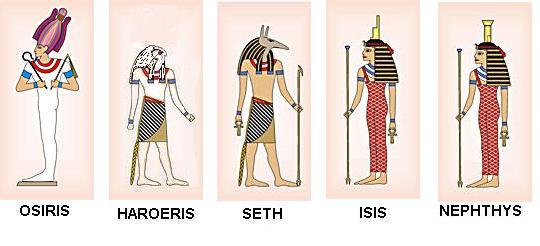
Interestingly, despite a curse from her father which left her barren, Nut seduced the god Thoth and gave birth to five more children: Osiris, Haroeris, Set, Isis, and Nephthys.
One Egyptian myth gives Nut vital powers in the sequence of day and night. In reference to Nut as a lover, Egyptians believed that Nut and Geb separated during the day. In the evening, Nut would come down to Earth to meet with Geb. Her absence from the sky resulted in darkness.
Another myth refers to Nut as the mother of Ra, where Ra uses her body as a pathway for the sun in the sky. Every night, Nut swallows Ra, then gives birth to him every morning to start the day anew. The Pyramid Texts of the pharaoh Pepi tell this story and reveals Nut as the “Great Goddess of the Sky”. In this form, she is the mother of all life and the one who receives all spirits.

Nut’s Appearance
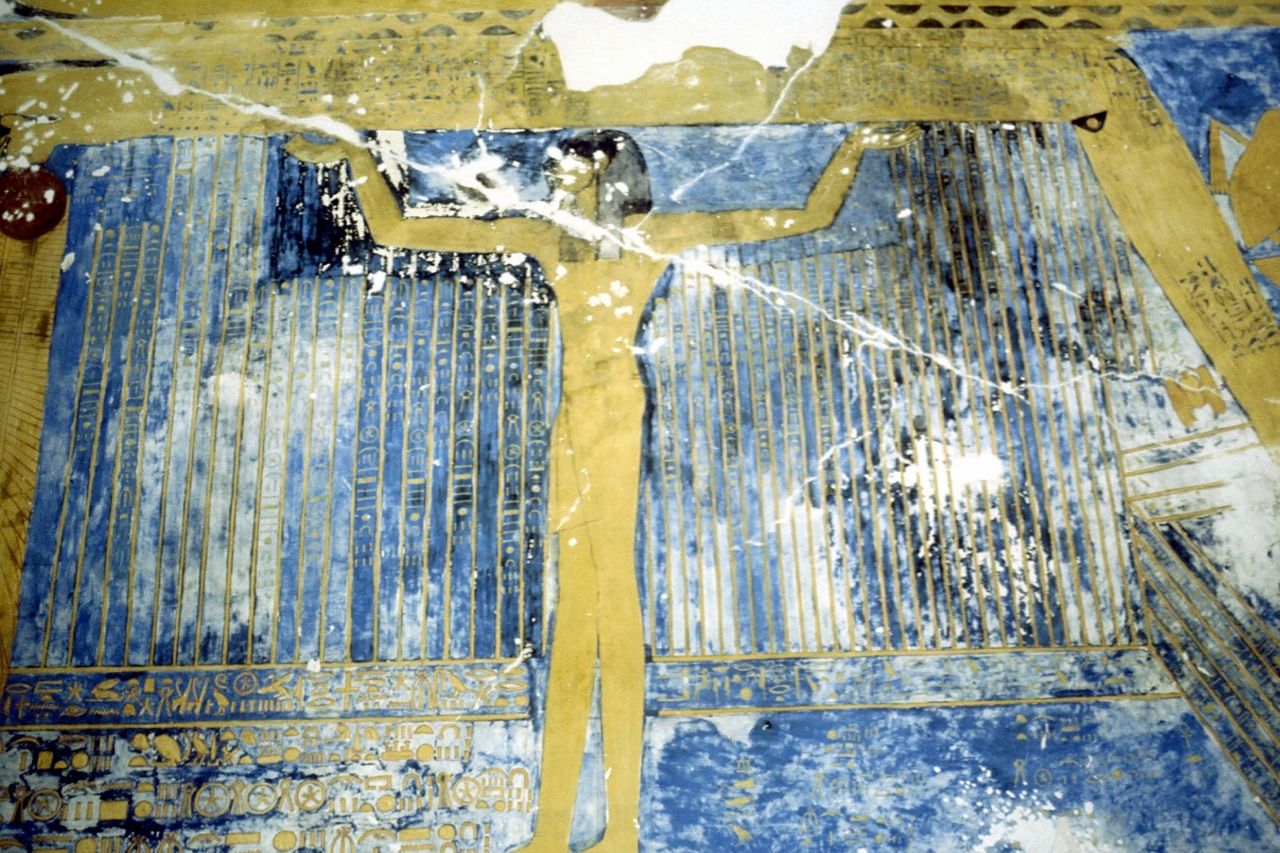
Nut’s appearance varied in many ways throughout Egypt. Some pictures depict her sitting with a water pot on her head. The hieroglyph for her name is also a water pot, which Egyptologists believe represented a womb.
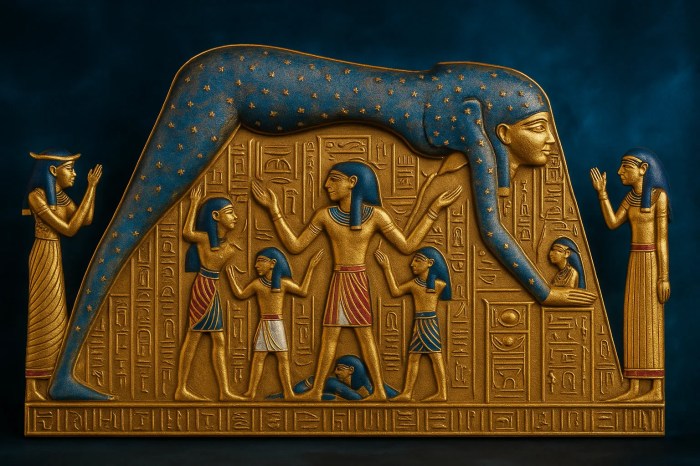
One of the most common forms of Nut features her as an arch stretching over the earth, which was found in the tomb of Ramses VI in the Valley of the Kings. Her body forms a semi-circle with only her fingers and toes touching the ground. In some versions, her father, Shu, holds her up. Her husband, Geb, reclines underneath her and represents the hills and valleys of the earth. Golden stars cover her body to represent the souls of her children.
Nut is often featured inside of coffin lids as a symbol of the sky over the deceased soul in the afterlife. In this form, she was known as the goddess of death. Almost every sarcophagus located at the Cairo Museum features the figure or face of Nut inside the lid. Some coffins feature her as having protective wings, while others symbolize her as a ladder. Her role in the afterlife tied closely with the view of her as the ultimate mother. The journey of death would bring the dead back to the arms of the goddess-mother Nut, much like night would bring Ra back to her.
Other less common forms feature her as a giant sow with many suckling piglets. Egyptians believed her piglets to be the nighttime stars, which Nut would swallow every morning. In other representations, she’s a cow goddess with eyes representing the sun and the moon.
Protector of the Dead
Nut was intimately associated with the afterlife. She was believed to shelter and rejuvenate the souls of the dead within her star-spangled body, offering them the possibility of rebirth. Stars were thought to be the souls of the dead or, in some interpretations, droplets of milk from Nut’s udders. This reinforced her role as a nurturer and caretaker, with the Milky Way itself serving as a representation of her nourishing abundance. The ceilings of many tombs in the Valley of the Kings were adorned with images of Nut, intended to ensure the protection of the deceased’s soul.
A Celestial Mother
As the mother of Ra and the one through whom he is reborn every day, Nut was considered the ultimate mother figure. Her maternal aspect made her an important deity in matters of life and fertility. The comfort and care she provided to the sun god each night were extended, metaphorically, to the people of Egypt as well.
Nut’s Worshipers
Nut’s chief shrine was located at Heliopolis. Worshipers in Memphis sought Nut as a healing goddess at a shrine called the House of Nut. A sycamore tree symbolized her home, but she was later replaced in the tree by the goddess Hathor. Despite being a central part of Egyptian worship, she had no known temples built exclusively for her.
Nut would also be associated with Hathor at Dendera. Texts at the Temple of the Birth of Isis reveal how Isis was born at Dendera under the watchful eye of Hathor. Tourists still view inscriptions and reliefs of Nut at Dendera which revealing her both astronomical importance and her religious importance as the mother of all creation.
Nut’s position between the heavens and the earth became the medium through which cosmic cycles could manifest. Her body, adorned with celestial bodies like the sun, moon, and stars, portrayed the heavens in motion – the moon waxing and waning, the sun rising and setting, and the stars marking the seasons and the passage of time. Each was a reminder of the precision and regularity of the universe, embodying the idea that life, death, and rebirth were all part of an unending cycle overseen by the divine.
The symbolism here is rich and multi-layered. Nut’s expansive presence across the sky signified protection, not just from the physical elements, but also from the metaphysical threats of chaos and disorder.
The Egyptians saw their world as one of balance and ma’at (harmony,) which the outstretched form of Nut helped maintain. Through her, the daily renewal of life was ensured, and the transition of souls to the afterlife was safeguarded.
The inter-connectedness of Nut, Geb, and Shu shows that the earth cannot exist without the sky, the dead cannot pass on without the living, and time itself is reliant on the motion of celestial bodies. They symbolize the underlying unity that binds all aspects of creation together.
Question: If you were a Goddess,
what would like your offspring to be like?
Sources:
Ancient Egypt
Anthropology Review


I think Nut is my favorite so far for reasons that I can’t even explain. If was a goddess, my kids would be exactly who they are. 🤣 Princess Pony Boy and Princess Lulu Belle 💝
LikeLiked by 1 person
I’m glad you connect with Nut. Lots to like about her. Lovely your children are already the offspring of a goddess.
LikeLiked by 1 person
She seemed to take on greater and greater significance!
Tony (Danab Cycle)
LikeLiked by 1 person
<3
LikeLike
Nut is a favorite of mine, and I love her representations in Egyptian art, covered with stars.
I would love to give birth to stars. Perhaps we do, being made of stardust ourselves. (K)
LikeLiked by 2 people
Kerfe, thank you for suggesting Nut to me. She is an amazing goddess. Yes, maybe we do. “We are stardust, we are golden.” a part of every thing. I love how she is depicted in art also.
LikeLiked by 1 person
😊🌃
LikeLiked by 2 people
Wow, so interesting. An older brother of mine was deeply into Egyptology when I was a kid, and that was my introduction to mythology, soon followed by Greek mythology in junior high.
As a goddess, I would like my offspring to be nurturing protectors and caregivers like Nut. Our world needs a lot of that.
LikeLiked by 2 people
Steve, I know you have talked about your brother’s record collection a time or two and now about his ancient mythology interests. Having an older sibling was a big plus for you.
I know your offspring would be benevolent, no question about it <3
LikeLiked by 2 people
Aww, thanks, Lisa, that’s kind of you to say. 🙏🏼
And the brother with a record collection (cool that you remember that detail… a lot of good music came to me through that collection, as you can imagine), that is actually another brother; I have three and a sister. They have all influenced me in some way or another.
LikeLiked by 2 people
Wow, House of Nut takes all the responsibilities then. Of every gods and around.
LikeLiked by 2 people
PH, sure seems like it.
LikeLiked by 2 people
Librarian mythos continues (from Erin Penn) – the children would be Mother Board (goddess of computers), Dewy (god of the sorting, both the orderilyness and the compulsion), Henson and Kermit – twin gods of hand and string puppets, and Braille (goddess of book accessibility – audio, braille, book mobiles for delivery, and horseback books).
LikeLiked by 2 people
Erin, you would have a passel of very marvelous deity children. What a joy for you and the world.
LikeLiked by 1 person
She has such lovely imagery associated with her – the stars, the arch, a ladder… My children are already pretty perfect! But if I were a goddess giving birth to parts of creation, I think it would be fun to be the mother of trees.
https://nydamprintsblackandwhite.blogspot.com/2026/04/n-is-for-nursery-rhyme.html
LikeLiked by 2 people
<3 Happy you connect with Nut and yes, the mother of trees would be a true blessing.
LikeLiked by 1 person