
Oshun (West Africa)
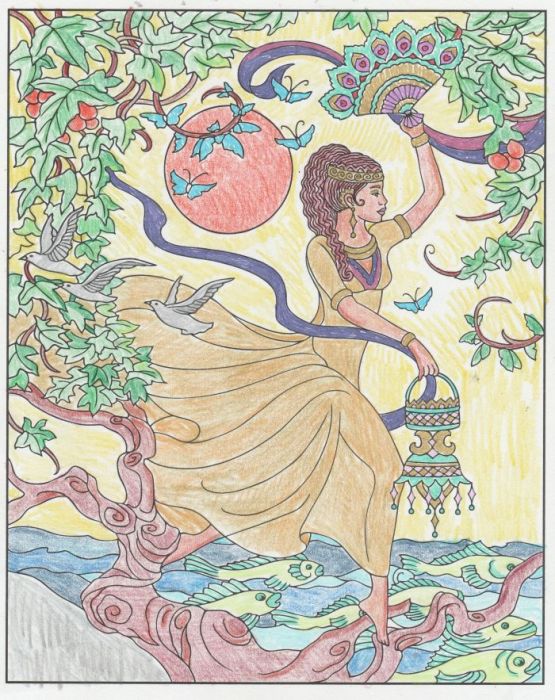
Oshun (also Ọṣun, Ochún, and Oxúm) is the orisha associated with love, sexuality, fertility, femininity, water, destiny, divination, purity, wealth, prosperity and beauty, and the Osun River, in the Yoruba religion.
According to the teachings of West African and West African-derived religions, the orishas are spirits sent by the supreme creator, Olodumare, to assist humanity and to teach them to be successful on Ayé (Earth.) Rooted in the native religion of the Yoruba people, most orishas are said to have previously existed in Ọ̀rún (the spirit realm) and then incarnated as humans on Earth. These orishas are called Irúnmọlẹ̀. The Irunmọlẹ took upon human identities and lived as ordinary humans in the physical world, but because they had their origin in the divine, they had great wisdom and power at the moment of their creation. Oshun is considered the most popular and venerated of the 401 orishas.
Mythology
Oshun was once the queen consort to King Shango of Oyo and was deified following her death.
A violín is a type of musical ceremony in Regla de Ocha performed for Osún. It includes both European classical music and Cuban popular music.
According to the Ifa Literary Corpus, Oshun was the only female orisha sent to assist Shango to create the world by Olodumare, the Supreme God. The other spirits sent ignored Oshun, who went to Shango for guidance.
One version of the story claims that female spirits were tempted to take matters into their own hands, but all of their creative attempts failed because they acted without male spiritual leadership. This version was possibly inspired by Abrahamic religions, with a patriarchal influence.
Another version, one more consistent with the beginning of the story, claims that the male spirits attempted to make the world without female influence, and this exclusion is what caused the world to fail. Regardless of the version, the myth ends with Shango forcing the other spirits to respect Oshun as they would him.
She is both a creative and destructive force, but her floods or droughts are recognized as a response to the actions of people who fail to honor her or the land with proper respect. Oshun is especially attentive to women, those seeking meaningful relationships, pregnant women, or those hoping to become pregnant. She is also invoked by women and men for luck, health, strength during times of challenge and change, and prosperity.
She was exported to the New World during the African Diaspora where she came to be known by many different names in the Caribbean, South, Central, and North America when Yoruba people were sold there as slaves. The Yoruba religion continues to be practiced by syncretizing it with Christianity, and she remains an important figure in the systems of Santeria, Vodou, and Candomblé. She is counted among the great fertility goddesses of world culture along with figures such as Aphrodite, Freyja, Frigg, Venus, Sauska, Astarte, and others and has become an increasingly popular goddess among women as a source of self-empowerment.
Oshun Today
Many women adopt Oshun as their personal deity, just as women have for centuries. Drawing on the ancient stories about her, devotees note her relevance in an age where people, increasingly ignore the values she stands for and insist on doing things their own way at a cost to the earth and each other. Those who seek empowerment from Oshun draw on her energies in pursuing personal and communal change which includes a heightened awareness of oneself and others as worthy of love, respect, and happiness.
These themes informed the 2016 album and film Lemonade by the recording artist Beyonce who drew on Oshun for inspiration and addresses her directly in the song Hold Up. The title of both album and film refers to the old adage, “When life gives you lemons, make lemonade”, encouraging people to make the best of any situation, but also reflects Oshun’s color yellow, linking her with light. Beyonce makes this association clear in the film where she is shown in an amber-yellow dress with gold bracelets. Gold is also associated with Oshun’s bright character as is honey which often symbolizes fertility.
The association of the adage with Oshun is also apt as gratitude for what one has, rather than regret over loss or bitterness over lack, is a central value of Oshun worship in which adherents are encouraged to recognize and be thankful for the gifts they have been given. Each year, people from many different countries arrive in West Africa to participate in observances centered on the concept of gratitude in honor of Oshun. In 2005, the Osun-Osogbo Sacred Grove, which forms a part of the area of the festival, was declared a UNESCO World Heritage Site, attracting more attention to the great goddess whose adherents worldwide gratefully acknowledge her gifts of beauty, love, and all that makes life sweet.
Question: If others threatened your goddess powers,
how would you respond?
Sources:
wikipedia
World History

 Tao-Talk
Such a rich and powerful portrait of Oshun; you really bring her complexity and relevance to life. True power lies in balance, respect, and honoring both ourselves and the world around us.
LikeLike
I never cease to be amazed by mythology and the complexity of the gods and goddesses, and their interrelationships. That’s very interesting about the Beyonce album riffing off the myth.
If anyone threatened my goddess powers? Easy: I’d smite them!
LikeLike