Pachamama (Peru)
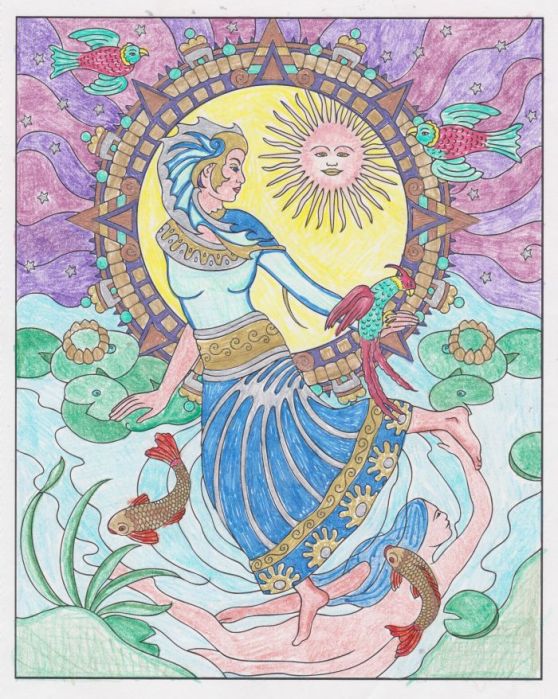
Pachamama, or Mother Earth, is a central deity associated with fertility in Andean beliefs. The goddess’s presence is strong in contemporary Andean communities, so much so that it’s central to many traditions. From ancient rituals to current cultural expressions, the Andean Earth Mother is widely present.
The term Pachamama comes from Quechua, the ancestral language of the Inca era, and literally means “Mother Earth“. “Pacha” means universe, world, earth, and even time, while “mama” translates as mother. Together, these terms define her as the deity who embodies the primary source of food, water, fertility, and life. This ancestral belief also connects with concepts such as love and protection.
Physical Attributes
Pachamama’s portrayal in Inca art reflects her serene and nurturing essence, capturing the beauty and abundance of the earth. Often depicted as a mature woman adorned with bountiful harvests, she symbolizes the fertility of the land and the sustenance it provides. Sometimes she appears as a mountain, embodying the very foundation of the world. She is also depicted as a serene adult female bearing harvests of potatoes and cocoa leaves, She is associated with sacred sites such as hallowed rocks and the revered boles of legendary trees, which serve as focal points for reverence and devotion. Pachamama’s significance extends beyond her physical form, encompassing the four cosmological Quechua principles of Water, Earth, Sun, and Moon, which she embodies as the ultimate Earth Mother deity
Powers and Abilities
Pachamama’s powers are as vast as the earth itself, reflecting her role as the sustainer of life as she governs the cycles of life and death, guides souls to the afterlife, and maintains cosmic order. She controls the weather, bringing rain to nourish crops and ensuring fertility throughout the land. She extends her realm into the spiritual, where she guides shamans and seekers toward harmony with the earth.
She nurtures crops, sustains animals, and forms the foundation of human existence. When disrespected, her wrath can cause earthquakes, which prompts rituals and offerings to appease her. The principle of reciprocity, known as Ayni in Quechua, underscores the importance of giving back to the earth, fostering a balanced relationship between humanity and nature.
Pachamama is revered as a fertility goddess, overseeing planting and harvesting rituals. She is depicted as an ever-present and independent deity. Offerings of llamas, guinea pigs, and intricate garments are sacrificed to honor her, ensuring her continued benevolence. Throughout history, the Inca described Pachamama as a dragon beneath the mountains.
Spiritual beliefs played a central role in the daily life of pre-Columbian civilizations. The Incas recognized their beliefs about nature and sacred forces, which were present in their daily lives. They considered Inti (the sun god) their supreme deity, along with other fundamental deities such as Wiraqocha, the Apus (mountain spirits), and Quilla. All these were integral to their daily activities, including customs, festivities, traditions, and many others. Pachamama was one of the most important because of her role in agriculture. Her importance was such that the ancient people constantly offered tributes and rituals in her honor. They intended their actions to invoke fertility and abundance in their lands, thus ensuring bountiful harvests throughout the year.
In 1532, Spanish forces invaded the Inca Empire in South America, specifically targeting the Inca civilization. After looting valuable artifacts, destroying structures, and subjugating the native peoples, the next step was to eradicate native beliefs. The aim was to replace all pagan beliefs with Catholicism. To achieve this, they took concrete actions, one of the most frequent being the construction of churches atop sacred temples.
Over time, Inca customs persisted despite their prohibitions, though largely unnoticed by the Spanish. Their artwork, rituals performed in hidden locations, and the blending of both beliefs reflected this. Thus, the presence of their traditions and deities remained intact, albeit somewhat more concealed. Tributes to the ancestral belief were no exception, and to this day, locals still regard her as an important figure.
According to the Andean worldview of the Incas, Pachamama is the mother who nourishes and sustains all living beings. This goddess fertilizes the fields and brings abundance to the harvests and well-being to the community. She is part of the Andean duality, that is, the complementarity of one another, in this case, the god Inti. As an element that fulfills the feminine role of its masculine counterpart, she is of utmost importance.
The Andean peoples believe that the Andean earth deity not only provides resources but also demands respect and reciprocity. For them, giving and receiving are fundamental aspects that maintain balance. From a Western perspective, nature is often viewed as a resource to be managed or exploited. In contrast, the Andean worldview sees Pachamama as a relational being rather than an object. Instead of ownership, there is reciprocity; instead of control, there is balance. This difference explains why many Andean communities prioritize harmony with the land over economic gain.

TUCUMAN, AMAICHA DEL VALLE, ARGENTINA – MARCH 03, 2019: Pachamama Museum in Tucuman Province, Argentina
Despite modernity and globalization, devotion to the earth goddess remains alive. Many people today practice rituals in veneration of the Andean earth deity, including Peru, Bolivia, Ecuador, and Argentina. Rituals, ceremonies, and offerings are a fundamental part of reciprocity with Mother Earth. Some of these are:
Pago a la Tierra (Despacho) is a ceremony where participants offer objects in honor of the earth. An Andean priest generally performs this ritual and must strictly follow a series of steps. Among the main symbolic offerings are coca leaves, candies, food, and drinks. The participants usually wear typical Andean clothing and other symbols of Andean identity and heritage.
Pachamama Day – August 1 is a day that coincides with the earth’s rest period according to the harvest calendar, so it’s an auspicious time. Besides, rituals, offerings, dances, songs, and more are some expressions of gratitude that take place in the Andean regions.
The Challa Ceremony consists of offering libations of products to the earth, such as beverages, coca leaves, alcohol, and food. Although it is frequently during the planting and harvesting season, the challa is a recurring practice among Andean people. People also make these offerings to give thanks for the food and to ask for prosperity.
The Minga Tradition which is collective work, often agricultural and construction tasks, for the benefit of the community in which they live is also known as Minga. People link this practice to the earth goddess because they ask for her blessing and the success of their work together.
Question: What would your physical
appearance be as a goddess?
Sources:
MachuTravelPeru
Mythlok


Thank you for sharing such a fascinating post, Li. I’m learning about so many mythological figures from your posts…never knew these existed.
If I were to be a Goddess, I’d love to be Mother Goddess Durga or ‘Shakti’ (from the Hindu mythology) since she is all powerful and has ten arms to protect her devotees and maintain the cosmic order. Each hand holds a weapon gifted by the various gods including a trident, discus, sword, and conch, amongst others that represent her capacity to eliminate evil and uphold righteousness in the world. It’s a very fascinating story, in case you’d like to research on her.
LikeLiked by 3 people
You are very welcome. I remember reading about Mother Goddess Durga before and was impressed with her powers.
LikeLiked by 2 people
Thanks yet again… and I love that picture
LikeLiked by 2 people
:)
LikeLiked by 2 people
Lisa, it’s so interesting how each mythological culture has deities devoted to fertility of the land, sea and air and of all life in it. Physical description… that’s a truly tough one. I think I’d favour a human-like appearance to be more approachable, yet with enough vestments etc. to differentiate me from mortals, while still being seen as their go-to for care and nurturing. Good questions! 😎
LikeLiked by 2 people
Steve, I think of when they first originated and see why they were in order to be kind to the humans who needed food and water. I think I’d like to be an amphibious goddess with both lungs and gills, webbed fingers and toes, and long seaweed-y hair.
LikeLiked by 2 people
Makes sense re: the origin stories. I like your answer on the appearance!
LikeLiked by 2 people
:)
LikeLiked by 2 people
A wonderful peaceful and empowering post. Thanks Jade. (K)
LikeLiked by 2 people
K, I’m glad you enjoyed the post. I like how they still honor her in gentle ways.
LikeLiked by 2 people
Yes. The Catholic church was unsuccessful in trying to eliminate the old gods in the new world.
LikeLiked by 1 person
Nice to see South America represented.
Tony (Danab Cycle)
LikeLiked by 2 people
Librarian mythos: The goddess may be page white or black ink or tanned vellum, pictures and words appear on her arms and legs. She dresses conservatively for most cultures, yet practically – with the ability to carry books easily, read unencumbered. She walks freely. Hands may be gloved (see her magic items of power) but are usually bare except for one hand with the rune for learn on the back of left hand and remember on the right. Her eyes and hair are as black as ink; the hair may be straight or kinky, and is usually tied back with a shawl or kerchief (practical). You can pick out her icon, because there will always be a book in one of her hands. – Erin Penn
LikeLiked by 1 person
I love your developing Librarian mythos, Erin.
LikeLike
I like her importance in advocating harmony with the earth. We are its keepers. So interesting, Lisa!
LikeLiked by 1 person
I love goddesses who use their powers for good.
LikeLike
I like this line:
The Andean peoples believe that the Andean earth deity not only provides resources but also demands respect and reciprocity.
I see god as light.
LikeLiked by 1 person
You’re right about the reciprocity, it’s the least we can do for the gifts we are given. God as light makes sense, as no life is possible without it.
LikeLike
cool there is a day named after this goddess! 💜💜
LikeLiked by 1 person
I like the idea of being a mountain, although Nut’s arch over the earth is also pretty cool. But whatever shape I am, I don’t want people sacrificing living things to me!
https://nydamprintsblackandwhite.blogspot.com/2026/04/p-is-for-pandora.html
LikeLiked by 1 person
Yes, both would be awesome, and living sacrifices wouldn’t send a good message I don’t think. Maybe baked goods? Key Lime Pie? :)
LikeLike