
Qin Liangyu (Chinese)
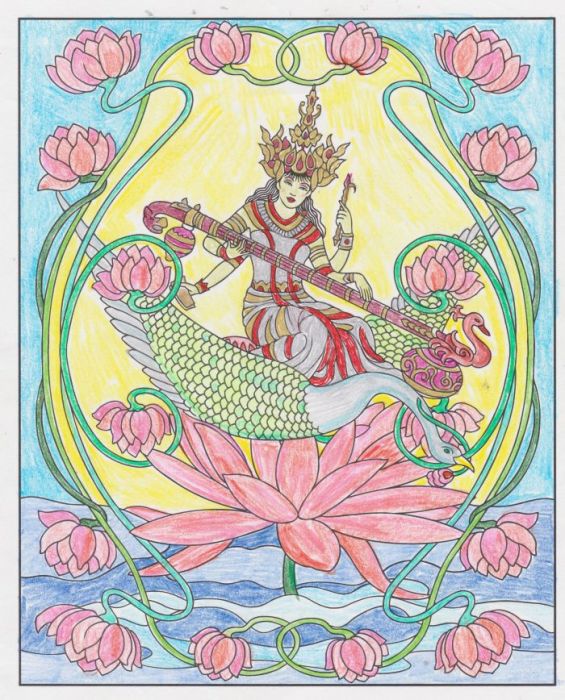
In my research, I learned that Qin Liangyu was not a goddess per se, but her importance in history makes her something close. Further, Marty Noble’s coloring book has her in it as a goddess, which is good enough for me. Finally, I note that the Marty’s image of her doesn’t match the history I found, but I’m still using it.
Qin Liangyu (b. 1574 – d. 1648,) posthumously known as Marquis Zhongzhen, was a female general best known for defending the Ming dynasty from attacks by the Manchu-led Later Jin dynasty in the 17th century. Please note: In this Chinese name, the family name is Qin; I will refer to her through the rest of this as Liangyu.
Liangyu was born in Zhongzhou (忠州,) Chongqing, to ethnic Miao parents. Her father, Qin Kui (秦葵,) obtained the position of a gongsheng (貢生) in the civil service examination. He believed that girls should receive the same education as boys, so he made Liangyu study history and the Confucian classics with her brothers. He also taught them martial arts. She learned martial arts more deeply than her brothers and became proficient in archery and horse-riding. She was also known for her skill in poetry.
In 1595, Liangyu married Ma Qiancheng (馬千乘,) the “Announcing and Pacifying Commissioner,” of Shizhu County and accompanied him in minor battles against local warlords in the southwestern border of the Ming Empire. They had a good marriage and he often sought her advice. In 1599, when Yang Yinglong (楊應龍) started a rebellion in Bozhou (播州; present-day Zunyi, Guizhou,) Ma Qiancheng brought 3,000 riders with him to suppress the revolt while Liangyu brought an additional 500 to support her husband. They successfully quelled the rebellion and destroyed the rebels’ camps.
In 1613, Liangyu’s husband offended an influential court eunuch and ended up being arrested and imprisoned; dying later in prison. Liangyu took over her husband’s official role. Those under her command were known as the White Cavalry (白杆兵.)
In 1620, Liangyu’s elder brother led 3,000 White Cavalry to Liaodong to resist invaders from the Manchu-led Later Jin dynasty. He was killed in action at the Battle of Hun River (渾河之戰.)
In 1623, Liangyu assisted Ming forces in suppressing the She-An Rebellion in Sichuan and Guizhou. In the following year, another of her brothers was killed in battle.
In 1630, when Later Jin forces besieged the Ming capital, Beijing, Liangyu led forces from Sichuan to reinforce the capital. The Chongzhen Emperor showered her with praises in poetry and presented her with four poems as she passed through Beijing.
In 1634, when Zhang Xianzhong’s rebel army invaded Sichuan, Liangyu and her son, Ma Xianglin (馬祥麟,) led their troops to attack the rebels, defeated them at Kuizhou, and drove them away.
In 1640, Liangyu defeated another rebel force led by Luo Rucai (羅汝才) in Kuizhou and Wushan. In recognition of her contributions to the Ming Empire, the Chongzhen Emperor appointed her as the Crown Prince’s Guardian (太子太保) and awarded her the title “Marquis Zhongzhen” (忠貞侯; lit. “Loyal and Chaste Marquis”.)
In 1644, The Ming Empire was overthrown. Some Ming loyalists formed a remnant state, the Southern Ming dynasty, in southern China to resist the Qing dynasty. Its nominal ruler, the Longwu Emperor, also granted Liangyu a marquis title. Meanwhile, Sichuan was invaded again. Liangyu attempted to resist the invasion but was defeated and forced to retreat. Although most of Sichuan was conquered, Liangyu did prevent her soldiers from surrendering to the conqueror.
Liangyu controlled part of Shizhu County and her policy of agricultural self-sufficiency made her region attractive for refugees. She helped about 100,000 refugees to settle down in Shizhu.

In 1648, Liangyu died and was buried in present-day Yachun Village, Dahe District, Shizhu County, Chongqing. She was given the posthumous name “Zhongzhen” (忠貞; lit. “Loyal and Chaste”) and was survived by her son, Ma Xianglin (馬祥麟.)
Liangyu’s life, along with her weapons and armour, is showcased in a museum in Shizhu County, Chongqing. A statue of her is in the Ganyu Hall of the Shibaozhai in Zhong County (that was preserved during the Three Gorges Project.) Together with Hua Mulan, Liang Hongyu and He Yufeng, Qin Liangyu is one of the most well-known female warriors and heroines in China.
In the Twenty-Four Histories, Qin Liangyu was also the only woman whose biography was listed among the biographies of court officials and generals.
In Popular Culture
She sometimes appears as a door goddess, usually in partnership with Mu Guiying.
She is one of the 32 historical figures who appear as special characters in the video game Romance of the Three Kingdoms XI by Koei.
She appears as a playable Lancer class servant in the mobile RPG video game Fate/Grand Order.
The Baidu Wiki site has a wealth of information about Qin Liangyu if you want to know more about her.
Question: Would you want to be a warrior Goddess?
Source: wikipedia
 Tao-Talk

What a great piece, thank you for sharing. And, yes. 🙂
LikeLike
I am enjoying the series Li
LikeLike
Interesting story of this warrior. I wish she were depicted as a warrior in that image…..:-) I wouldn’t want to be a warrior goddess: too much to do 😆
LikeLike