
Rhiannon (aka Epona) Welsh
The Mabinogion
The Mabinogion is a collection of Middle Welsh prose. Compiled from texts found in two late-medieval manuscripts, this collection was initially edited and translated by antiquarians in the early nineteenth century. While the Mabinogion collection itself might thus be regarded as a nineteenth century editorial creation, its constituent texts are authentic medieval productions, deriving from originals composed between the eleventh and the fourteenth centuries. They represent a golden age of narrative prose that flourished in Wales over the course of the central middle ages. This distinctive and evolving literary culture forms the context of the Mabinogion.
Eleven separate tales are normally included within it, and within these, two subgroupings – ‘the Four Branches of the Mabinogi’ and the ‘Three Romances’ – are traditionally recognized.
The Mabinogion texts are concerned with the heroic age or mythological past of the British Isles. They were not original compositions, drawing as they did on pre-existing traditional material, whether from oral or written sources. But these traditions were reworked, often to reflect contemporary concerns. We might read the Mabinogion as both an interpretation of a mythological past and a commentary on the medieval present.
You might be wondering why am I introducing Goddess Rhiannon this way?
Rhiannon
Rhiannon is a protagonist of the Mabinogi, in its First and Third Branches. She has been described by Ronald Hutton as “one of the great female personalities in World literature“, adding that “there is in fact, nobody quite like her in previous human literature.”
In the Mabinogi, Rhiannon is a strong-minded ruler, a lady of the courts, and a devoted mother. She is intelligent, politically strategic, famed for her sophisticated conversation and striking looks, as well as her wealth and the generosity of her gifts, especially to minstrels.
In the First Branch Rhiannon chooses Pwyll, prince of Dyfed (south-west Wales,) as her consort, breaking her contract with Gwawl, another prince. Her fateful choice employs two hudiau (enchantments:) an uncatchable horse, and an almost unfillable bag. Rhiannon has a son, Pryderi, with Pwyll. The newborn child is abducted, but she is accused of infanticide. Fortunately Pryderi is restored to her, clearing her name.
In the Third Branch Rhiannon as a widow marries Manawydan, the usurped heir of the British royal family. She has further trials and adventures with him, her son and his wife, involving various enchantments: chiefly the Desolation of all Dyfed, seven years of vengeance by Gwawl’s magician friend, Llwyd.
Evidence of Rhiannon as Goddess
Rhiannon may have originally derived from both Mother and Horse Goddesses. There may be an inheritance in the traditions of the Mari Llwyd whose wassailing customs centre a horse skull, and match Rhiannon’s geographic distribution in Wales. The Adar Rhiannon (Birds of Rhiannon) also express her paradoxical enchantment power: far yet near, living and dead.
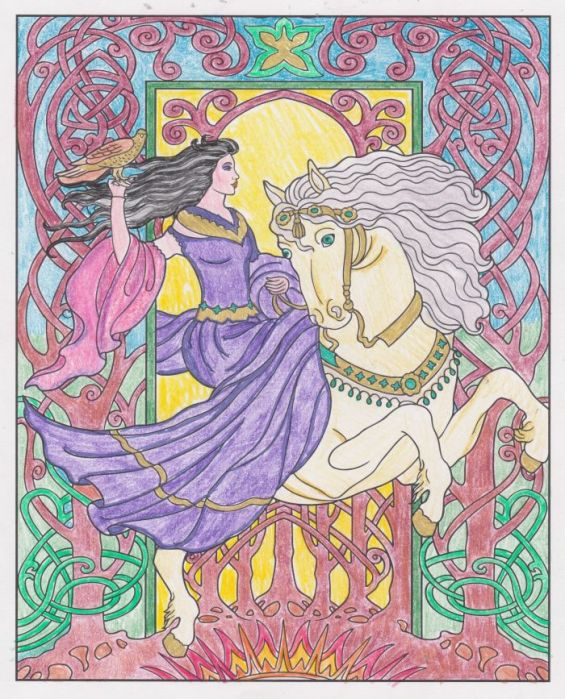
Rhiannon seems to inherit the traditions of an earlier Celtic deity, the Gaulish horse goddess, Epona. Rhiannon is strongly associated with horses, and so is her son Pryderi. She and her son are often depicted as mare and foal. Like Epona, she sometimes sits on her horse in a calm, stoic way. This connection with Epona is generally accepted among scholars of the Mabinogi and Celtic studies.
Her name has been linked to a linguistic reconstruction Brittonic form *Rīgantonā, derived from *rīgan- “queen” (cf. Welsh rhiain ‘maiden’, Old Irish rígain ‘queen’.)
When Rhiannon first appears she is a mysterious figure arriving as part of the Otherworld tradition of Gorsedd Arberth. Her paradoxical style of riding slowly, yet unreachably, is strange and magical, though the paradox also occurs in medieval love poetry as an erotic metaphor. Rhiannon produces her “small bag” which is also a magical paradox for it cannot be filled by any ordinary means. When undergoing her penance (for being thought to have killed her newborn son,) Rhiannon demonstrates the powers of a giantess, or the strength of a horse, by carrying travelers on her back.
Rhiannon is connected to three mystical birds. The Birds of Rhiannon (Adar Rhiannon) appear in the Second Branch, in the Triads of Britain, and in Culhwch ac Olwen. In the latter, the giant Ysbaddaden demands them as part of the bride price of his daughter. They are described as “they that wake the dead and lull the living to sleep.” This possibly suggests Rhiannon is based on an earlier goddess of Celtic polytheism.
One scholar’s position is that, [Rhiannon] “reincarnates the goddess of sovereignty who, in taking to her a spouse, thereby ordained him legitimate king of the territory which she personified.” Another scholar draws in the international folklore motif of the calumniated wife, saying, “Rhiannon conforms to two archetypes of myth … a gracious, bountiful queen-goddess; and … the ‘wronged wife’, falsely accused of killing her son.”
In Modern Times
Neo-pagan traditions — Rhiannon is included in the traditions since the 1970s, with varying degrees of accuracy in respect to the original literary sources.
Retellings of the Mabinogi (Mabinogion) – she appears in many of them
Fantasy Novel Appearances
Not For All The Gold In Ireland (1968) by John James
The Song of Rhiannon (1972) by Evangeline Walton
“Sion ap Siencyn” (1921) by Kenneth Morris features the magical songbirds of Rhiannon
The Sword of Rhiannon (1949) by Leigh Brackett
“The King’s Fool” (1984) Robin of Sherwood story
Fantasy Worlds
Three Hearts and Three Lions by Poul Anderson
The Secret World Chronicle by Mercedes Lackey and Others
Music
Rhiannon (1975) by Fleetwood Mac; Stevie Nicks wrote it after reading the novel, _Triad: A Novel of the Supernatural_, by Mary Bartlet Leader. There is mention of the Welsh legend in it, but the Rhiannon in the novel bears little resemblance to her original Welsh namesake. Nevertheless, despite having little accurate knowledge of the original Rhiannon, Nicks’ song does not conflict with the canon, and quickly became a musical legend.
Visual arts
In artworks, Rhiannon has inspired some entrancing images. A notable example is Alan Lee 1987, and 2001, who illustrated two major translations of the Mabinogi, and his pictures have attracted their own following.
Question: If you were a goddess,
what song would you choose
to have honor you?
Sources:
wikipedia
mabinogion info
 Tao-Talk
Very interesting story about Rhiannon! It’s a common Welsh name and I had a classmate by this name in Bristol…fascinating tale about “one of the great female personalities in World literature.” Thank you for sharing such amazing characters through your posts, Li. Loving this A2Z series!!
LikeLiked by 2 people
Esha, I knew the name by the Fleetwood Mac song but learned a lot writing this one up.
You are very welcome on sharing info on goddesses, as I am learning as I go as well.
LikeLike
❤️
LikeLiked by 1 person
I think I would select this song.
LikeLiked by 1 person
A perfect choice, Jim. She was Venus herself!
LikeLiked by 1 person
That the Welch function so apparently effortlessly alongside the British, despite a language that’s so strikingly different (obviously they’re multilingual) is something that astonishes me every time I think about it.
Tony (Danab Cycle)
LikeLiked by 1 person
Time and time again the Welsh surprise me, especially with their music. So many good musicians!
LikeLike
I always thought of her as the goddess of horses, so thanks for all the other history.
A song choice is so hard. Maybe something cheerful like the Judy Collins song “Open the Door”. (K)
LikeLiked by 1 person
That’s a great song. It suits you, K.
LikeLiked by 1 person
One of my favorites.
LikeLiked by 1 person
Such an engaging deep dive into Rhiannon and the layers of myth, symbolism, and reinterpretation around her.
LikeLiked by 1 person
Glad you enjoyed it, Tamara. There is a wealth of material for sure.
LikeLike
This is a very complex and interesting mythical figure, thanks for the profile of her. I wondered if the Fleetwood Mac song was inspired by her….
The question is a tough one. The first thing that comes to mind is “Morning Has Broken” by Yusuf/Cat Stevens as it’s such a beautiful tribute to creation.
LikeLiked by 1 person
Yes, she is, Steve. The one link I’ve included has a very lengthy amount of info on her and the times she lived in.
I love Morning Has Broken, “like the first morning” giving each of us a clean slate at the beginning of the day <3
LikeLiked by 1 person
Lisa, thanks for sharing all the information. It sure is an amazing “world.”
My thoughts exactly on the song. There’s so much beautiful imagery in it.
LikeLiked by 1 person
Librarian Lore (Erin Penn) – Reading Rainbow – https://youtu.be/4Ygs3IHJ2bM?si=AsYCm4L08sga00Ra
LikeLiked by 1 person
I love it! My kids and I watched this religiously when they were young.
LikeLike
storytelling and medieval social themes – something I definitely like :-D
LikeLiked by 1 person
PH, there is definitely a certain charm to these things. It’s been fun finding narratives with deities.
LikeLike
Oh it is too hard to pick just one song! Haha! X
LikeLiked by 1 person