
Tara (Hindu/Buddhist)
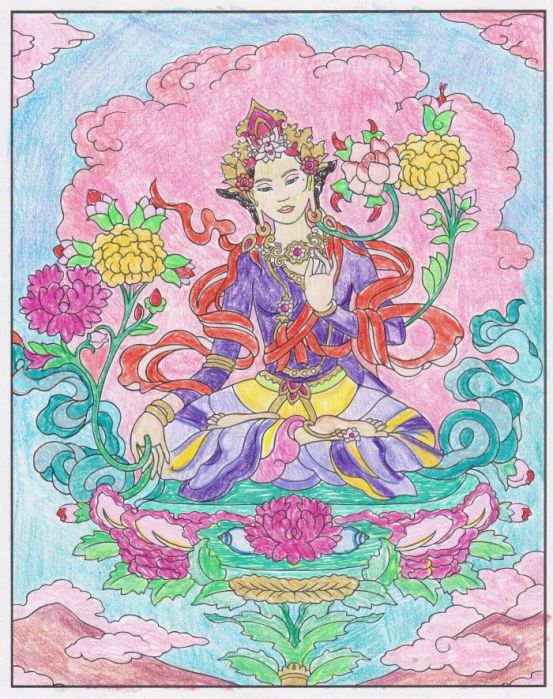
In the Shaivism and Shaktism tradition of Hinduism, the goddess Tara is the second of the ten Mahavidyas. She is considered a tantric – where tantra presents complex cosmologies, viewing the body as divine and typically reflecting the union of Shiva and Shakti — manifestation of Parvati. Parvati is one of the principal goddesses in Hinduism, revered as the goddess of power, energy, nourishment, harmony, love, beauty, devotion, and motherhood. Along with Lakshmi and Sarasvati, Tara forms the trinity, known as the Tridevi.
 Terapith Temple in West Bengal
Tara’s most famous center of worship is the temple and the cremation ground of Tarapith in West Bengal, India.
The commonly known origin of Tara is from the 17th chapter of the Rudrayāmala which describes the initial unsuccessful attempts of the sage Vasiṣṭha in worshipping Tara, and the subsequent meeting with the god Vishnu in the form of Buddha and his eventual success by the means of kaula rites. Tara protects her devotees from difficult dangers. Tara is all-pervading and also manifests on Earth.
Tara-related beliefs are probably an amalgamation of the beliefs linked to areas which have experienced Buddhist influence. The syncretism between Shaivist and Buddhist cults created a congenial atmosphere for the formation of the traditions of Tārā, both a Hindu and a Buddhist goddess.
Her pleasant forms were popular amongst the Buddhists. Some of her forms are worshipped in both Hindu and Buddhist systems.
Tara is often described as a fierce deity, holding kartrī (knife), khaḍga (sword), chamara (Fly-whisk) or indivara (lotus) and a single matted braid over her head. She is dark in complexion, tall, with a bulging belly, wears tiger pelts, with her left foot on the chest of a corpse and her right foot placed on a lion or between the thighs of the corpse. She has a terrifying laugh and is fearsome.
Hindu goddesses Kali and Tara are similar in appearance. They both are described as standing upon a supine corpse sometimes identified with Shiva. However, while Kali is described as black, Tara is described as blue. Both wear minimal clothing, however Tara wears a tiger-skin skirt, while Kali wears only a girdle of severed human arms. Both wear a garland of severed human heads. Both have a lolling tongue, and blood oozes from their mouths. Their appearances are so strikingly similar that it is easy to mistake one for the other. Tara is shown standing in the pratyalidha stance (in which the left foot is forward.). Her consort is Akshobhya, a form of Shiva who is in the form of a serpent coiled around her matted hair. She wears a crown made of 5 skulls connected with plates of bone.
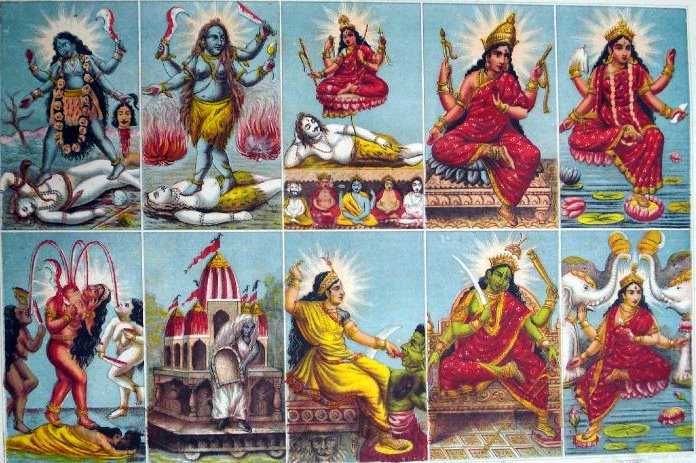
Top: Kali, Tara, Tripura Sundari, Bhuvaneshvari, and Bhairavi
Bottom: Chhinnamasta, Dhumavati, Bagalamukhi, Matangi, and Kamala
Modern Times
In Bengal, Ramprasad Sen addresses Tara as a daughter in his songs. Sadhak Bamakhepa also was a famous siddha of Tara in the modern era. These devotees introduced a public devotional dimension to the secretive tantric worship of this deity and emphasized her motherliness.
Question: If you were a goddess,
how many aspects would you like to have?
Sources:
Wikipedia


Librarian Lore (by Erin Penn) – The goddess looks up at the question from where she has squatted among children watching a puppet show performed by two of her priestesses/children librarians. A sly smile winks across her page-pale face, “How many aspects do I have? As many aspects as there are books in a library and languages with stories. I am an organized shelf, and a chewed on book by a babe. I am an university lecture and a fantasy bookboyfriend. I am a rage idea and a sorrowful memory. I am a reflection of you and something you have never seen before.”
LikeLiked by 1 person
Beautiful prose, Erin! I am smitten with your Library Goddess.
LikeLike
Tara has remained a popular name for generations. I don’t know if it matches the popularity of the 1980s though. So many girls named Tara back then.
LikeLiked by 1 person
Karen, I remember Tara from the TV series, Sons of Anarchy. Lucky woman was Jax’ girlfriend ;) I used to work with a woman named Tara.
LikeLike
That’s certainly one of the niftier aspects of Hinduism.
Tony (Danab Cycle)
LikeLiked by 1 person
What aspect? Polytheism?
LikeLike
I always thought of Tara as more peaceful than Kali, but evidently I was mistaken. But life often requires fierceness, so not surprising.
I’m not sure about aspects. I think there’s no escaping having many different sides. (K)
LikeLiked by 1 person
Kerfe, I would need to study them more to see. Each goddess shows us it is ok to have different aspects, I think.
LikeLiked by 1 person
Very true.
LikeLiked by 1 person
Sounds fascinating. But also sounds like one would not wish to see Tara, based on the visual description.
“Starting strong is good. Finishing strong is epic.” — Robin Sharma
J (he/him 👨🏽 or 🧑🏽 they/them) @JLenniDorner ~ Speculative Fiction & Reference Author and Co-host of the April Blogging #AtoZChallenge international blog hop
LikeLiked by 1 person
J, I tend to agree with you on not wishing to see Tara!
LikeLike
Like others, I’d be fearful of witnessing Tara. I guess in terms of aspects, I’d favour less threatening ones than hers!
LikeLiked by 1 person
Steve, I have to admit, the Hindu religion has some badass Gods and Goddesses!
LikeLiked by 1 person
Indeed, Lisa. Our meditation teacher taught us about many in the Hindi pantheon, and some are pretty fierce.
LikeLiked by 1 person
I love Tara–Bodhisattva and Goddess of Compassion. I feel calm just looking upon her in my minds eye. She is frequently depicted in a deep turquoise-green, very soothing to the eyes.
LikeLiked by 1 person
Josna, I’m glad you know her. They have depicted her as scary in those images, standing on a corpse, with a human skull necklace. Do you know why that is?
LikeLiked by 1 person
I would have thought that the goddess who fits that description would be Kali. I only knew of the Buddhist Tara. My mother had originally wanted to name me Tara. . .
LikeLiked by 1 person
Good to know, Josna. I like the name Tara, but Josna is a lovely choice by your mother.
LikeLiked by 1 person
very interesting post Li I loved reading all about Tara! X
LikeLiked by 1 person
I’d better stick to just one aspect, lest I confuse myself! But I might allow myself a little shapeshifting.
https://nydamprintsblackandwhite.blogspot.com/2026/04/t-is-for-trickster.html
LikeLiked by 1 person
Yes on the shapeshifting! I think you would make a good creator of goddesses.
LikeLike
Shakti/Durga/Parvati had many facets and each facet was given a name. From being one with grace to a fierce warrior, it is believed she has nine incarnations.
I enjoyed your post, Li.
LikeLiked by 1 person
Punam, thanks so much for the additional information. Glad you enjoyed it. I remember we had talked about Durga before but hadn’t realized she is another incarnation of Tara.
LikeLiked by 1 person
You are very welcome, Li. ❤️
Oh yes, we did talk about Durga when we used to respond to Octpowrimo!🙂 Goodness, how time flies!
LikeLiked by 1 person
<3
LikeLiked by 1 person