
Urania (Greek) One of the Nine Muses
 The nine Muses on a Roman sarcophagus (second century AD)—Louvre, Paris
The Nine Muses
Nine Muses in Greek mythology were goddesses who presided over the arts and sciences. They began as nymphs, whispering inspiration to those who invoked them. Over time, they evolved into powerful goddesses, responsible for human inspiration in various artistic and intellectual pursuits. They were believed to be the daughters of Zeus, the king of the gods, and Mnemosyne, the Titaness of memory. Their birth reflects the power of memory in a largely illiterate society, where remembering the works of poets, scientists, and storytellers was essential. After their birth, the Muses were cared for by the nymph Eufime and the god Apollo, who raised them and taught them the arts.
The Nine Muses each guided and inspired a specific creative or intellectual field:
Calliope: The Muse of epic poetry and eloquence. She is considered the chief of the Muses and is said to have inspired Homer in writing The Iliad and The Odyssey. She is often depicted with a writing tablet, scroll, and pen.
Clio: The Muse of history. She is responsible for preserving memory and the knowledge that comes from discoveries and investigations of the past. Clio is often depicted with a scroll or a book. She is also credited with introducing the Phoenician alphabet to Greece.
Erato: The Muse of lyric or erotic poetry. Her name means “lovely,” and she is said to make those who were guided by her desirable and worthy of love. Erato is often depicted with a lyre, hymns, and a wreath of roses.
Euterpe: The Muse of music, specifically lyric poetry and flute playing. Her name means “giver of pleasure.” She is credited with developing various musical instruments, including the aulos. Euterpe is particularly associated with wind instruments. She is often depicted with a flute.
Melpomene: The Muse of tragedy. She is often depicted with a tragic mask, leather boots, and a knife or stick in her hand.
Polyhymnia: The Muse of sacred poetry, hymns, and religious ceremonies. She is also associated with geometry, meditation, and agriculture. Polyhymnia is often depicted wearing a tunic and veil, appearing thoughtful and serious.
Terpsichore: The Muse of dance and choral song. She is often depicted with a lyre.
Thalia: The Muse of comedy and idyllic poetry. Her name means “rich festivity” or “blooming.” She is often depicted with a comic mask and an ivy crown.
Urania: The Muse of astronomy and astrology. She is often depicted dressed in blue, holding a globe and compass, and wearing a star diadem or having stars on her dress. In some accounts, she is identified as the eldest of the Muses.
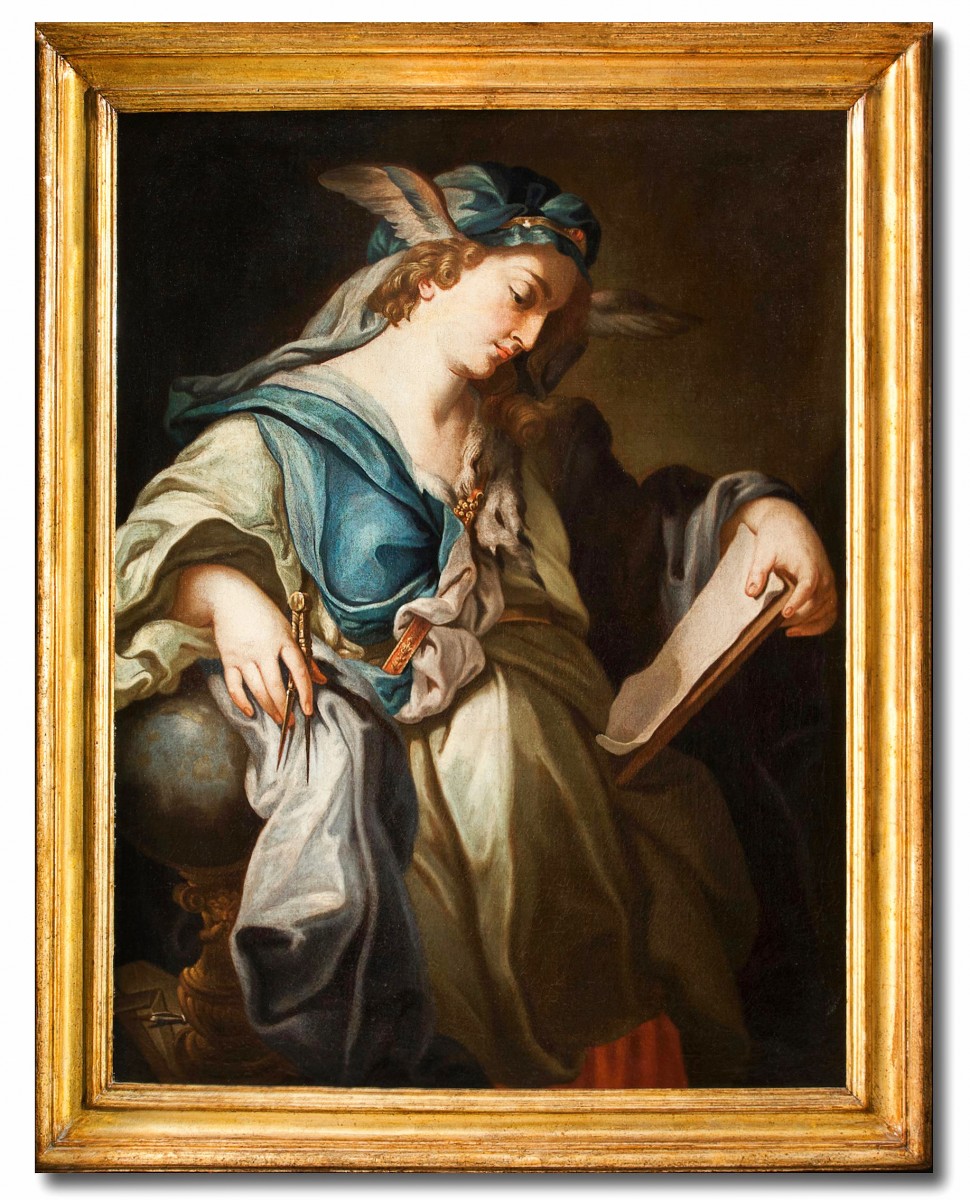
Urania, Muse Of Astronomy, attributed to Francesco Trevisani (1656 – 1746)
Urania, o’er her star-bespangled lyre,
With touch of majesty diffused her soul;
A thousand tones, that in the breast inspire,
Exalted feelings, o er the wires’gan roll—
How at the call of Jove the mist unfurled,
And o’er the swelling vault—the glowing sky,
The new-born stars hung out their lamps on high,
And rolled their mighty orbs to music’s sweetest sound.
—From An Ode to Music by James G. Percival
Urania’s name itself is derived from the Greek word “ouranos,” which means “heaven” or “sky.”
Urania was the daughter of Zeus by Mnemosyne and also a great-granddaughter of Uranus. She is regarded by some as the mother of the musician Linus and Hymenaeus. She is often associated with Universal Love. She’s sometimes identified as the eldest of the divine sisters. She’s said to have inherited her father’s majesty and power and her mother’s beauty and grace.
Urania dresses in a cloak embroidered with stars and keeps her eyes and attention focused on the Heavens. She is usually represented with a celestial globe, to which she points with a little staff, and is depicted in modern art with stars above her head. She is able to foretell the future by the arrangement of the stars.
Those who are most concerned with philosophy and the heavens are dearest to her. Those who have been instructed by her she raises aloft to heaven, for it is a fact that imagination and the power of thought lift our souls to heavenly heights.
Urania in Art & Literature
During the Renaissance, Urania began to be considered the Muse for Christian poets. In the invocation to Book 7 of John Milton’s epic poem Paradise Lost, the poet invokes Urania to aid his narration of the creation of the cosmos, though he cautions that it is “[t]he meaning, not the name I call.”
Renaissance artists Raphael and Giorgione, among others, created stunning works that featured Urania.
In literature, Urania is mentioned in various ancient texts, including the works of Hesiod and Ovid.
Urania in astronomy and navigation
Urania’s impact can be seen in the works of famous astronomers such as Hipparchus and Ptolemy, who laid the foundations for modern astronomy. These scholars studied the positions and movements of celestial bodies, often attributing their insights to the inspiration they received from Urania. The Greeks also created elaborate myths and stories that celebrated her contributions, further solidifying her importance in their culture.
The planet Uranus, though mostly named after the Greek god personifying the sky, is also indirectly named after Urania.
Urania is the namesake for astronomical observatories in Berlin, Budapest, Bucharest, Vienna, Zürich, Antwerp, and Uraniborg on the island of Ven. The main belt asteroid Urania was also named after her.
The official seal of the U.S. Naval Observatory portrays Urania. Hr. Ms. Urania is a sail training vessel for the Royal Netherlands Naval College. There has been a Hr. Ms. Urania in the Royal Netherlands Navy since 1832.
Urania is featured on the seal of the Royal Astronomical Society of Canada, as well of its motto: Quo ducit Urania (“Where Urania leads”.)
Urania’s influence on astrology can be seen in the way astrologers often invoke her name when interpreting celestial charts. Her guidance is believed to provide insights into the relationships between celestial events and human experiences. The study of astrology not only reflects a fascination with the cosmos but also highlights the inter-connectedness of all things, a concept that Urania embodies. Her role is essential in understanding the ancient Greek view of the cosmos and the influence of celestial bodies on human life.
Question: If you could be one of the Muses,
which one would you be and why?
Sources:
wikipedia
World Mythos
Greek Mythology.com
 Tao-Talk
I love the greek mythology .
LikeLiked by 2 people
I knew there were muses but not what each one represented. They are wonderful beings. I’ve been loving this month long exploration of goddesses (and demi-goddesses.)
LikeLiked by 3 people
I liked this one a lot, Lisa. Jupiter laid with one of his Aunts, the Titaness Mnemosyne and for nine straight days they made love, and this divine coupling produced the nine muses. The nine Muses are the sister goddesses of music, poetry, and other artistic and intellectual pursuits, and they are looked at as being the protective and supervisory goddesses of sacred festivals and banquets, and the patronesses of polite and useful arts. I have a story in my second book about the Muses being challenged into a singing contest by the Pierides, that was judged by the nymphs and the Muses were declared the winners. The Muses turned the Pierides into magpies, so they would not dare to ever be so insolent again and they were forced to live out their lives as chattering birds.
LikeLiked by 3 people
Jim, I had no idea that Jupiter was the nephew of Mnemosyne! Thanks for the additional info on them and their offspring. Very cool you have a story about the Muses in your 2nd book.
LikeLiked by 1 person
Jupiter was the Roman name for Zeus, and the gods had no problem with incest.
LikeLiked by 3 people
Between incest and smiting, it’s a wonder they found time for much else.
LikeLiked by 2 people
This is so interesting!
LikeLiked by 1 person
:) Glad you find it interesting. I do also.
LikeLiked by 1 person
I think I would like to be Erato! Quite a change from my normal life 😀
LikeLiked by 3 people
Sounds quite lovely, Paula. I could see you as Erato!
LikeLike
I probably heard of these muses…but I cannot remember. Zeus was the main one I read about…and watched on Saturday mornings along with Isis.
LikeLiked by 1 person
Max, I’m not sure I ever saw them all in one place or not. I remember Shazam and Isis vaguely in cartoons.
LikeLiked by 1 person
On Shazam…all of them are shown quickly…in the intro…I had to go look it up…I thought I was going crazy lol.
Apollo, etc….
LikeLiked by 1 person
Where’s Isis??? Wow I don’t think I ever saw that show before. The old man as “The Mentor”
LikeLiked by 1 person
Oh this is the Isis I used to watch.
LikeLiked by 1 person
Wow, I do not remember this at all. I see 1975 date on it, which was my high school years. Looks pretty good!
LikeLiked by 1 person
I watched these religously every Saturday morning. They would play one after another. She was beautiful!
LikeLiked by 1 person
I remember growing up Saturday morning cartoons was THE thing to do. I loved those Saturday mornings. I see she has that “Mary Ann” look that you like :)
LikeLiked by 1 person
On cold mornings I would put a blanket over the heating duct and settle in for a great morning! I loved them as well…oh yes! She did!
LikeLiked by 1 person
:)
LikeLike
Another fascinating write-up. Thank you for telling the stories of the Muses. Urania is very cool, though if I could be one of them, I think it would be Polyhymnia as her duties are all very important aspects of life, especially spiritual life.
LikeLiked by 1 person
Steve, Polyhymnia has so many wonderful attributes, I can see why you would pick her.
LikeLiked by 1 person
A wonderful choice–she would be my choice anyway. The word “muse” has been stripped of much of its agency by our current culture. Not mere accessories, the Muses are important components of all creation. (K)
LikeLiked by 2 people
<3 <3 <3 Kerfe, I again have to thank you for suggesting them when I was looking for goddesses to write about. You've greatly enhanced this A2Z with your suggestions. Well-said, they are not mere accessories! You are going to love my choice for tomorrow. Guaranteed.
LikeLiked by 1 person
🧡
LikeLiked by 1 person
Oh, certainly Kaliopee.
Tony (Danab Cycle)
LikeLiked by 1 person
Excellent choice, Tony!
LikeLike
My previously meagre knowledge with the Muses was through comic books. Specifically, Neil Gaiman’s Sandman. I knew when I was reading it that there was more to the story than I could understand and will go back and read it again with fresh eyes.
Thanks Lisa, for your information here.
LikeLiked by 1 person
My pleasure, Shaun.
LikeLike
This is a great post. I especially like the mentions of where she is honored in art and namesakes. I will be checking those out!
Lori
LikeLiked by 1 person
Thanks, Lori!
LikeLike
Long long ago when we did a Greek mythology unit in ninth grade, there was a culminating presentation in which everyone had to dress up as a figure from Greek mythology. I dressed as the muse Clio. But Urania is appealing, and Polyhymnia has a really interesting collection of attributes…
https://nydamprintsblackandwhite.blogspot.com/2026/04/u-is-for-unicorn.html
LikeLiked by 1 person
What about the idea of cycling through muse attributes, a new one every month. Wouldn’t that be amazing?
p.s. sounds like you had a wonderful 9th grade teacher. kids remember things like that.
LikeLike
For a long time I wanted to be Thalia.
LikeLike