White Buffalo Calf Woman
(Ptesan-Wi) Lakota (Sioux)
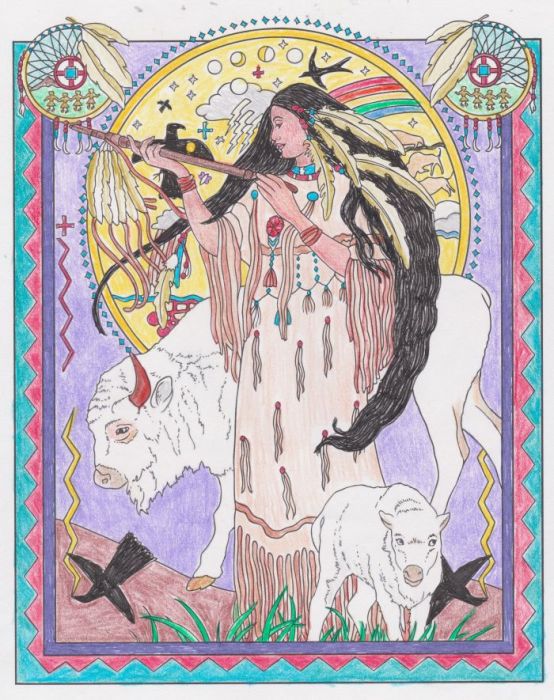
There are several variations of the story of White Buffalo Calf Woman. From Crystal Links:
The White Buffalo Calf Woman, in Lakota mythology, is a sacred woman of supernatural origin who gave the Lakota their “Seven Sacred Rituals.”
The traditional story is that, long ago there was a time of famine. The chief of the Lakotas sent out two scouts to hunt for food. As the scouts traveled they saw a figure in the distance. As they approached they saw that it was a beautiful young woman in white clothing.
One of the scouts was filled with desire for the woman. He approached her, telling his companion he would attempt to embrace the woman, and if he found her pleasing, he would claim her as a wife.
His companion warned him that she appeared to be a sacred woman, and to do anything sacrilegious would be folly. The scout ignored his advice. The companion watched as the scout approached and embraced the woman, during which time a white cloud enveloped the pair. After a while, the cloud disappeared and only the mysterious woman remained.
The remaining scout was frightened, and began to draw his bow, but the woman beckoned him forward, telling him that no harm would come to him.
As the woman was fluent in Lakota, the young man decided she was one of his tribe, and came forward. When he arrived, she pointed to a spot on the ground where the other scout’s bare bones lay. She explained that the Crazy Buffalo had compelled the man to desire her, and she had annihilated him.
The scout became even more frightened and again menaced her with his bow. At this time, the woman explained that she was Wakan and his weapons could not harm her. She further explained that if he did as she instructed, no harm would befall him and that his tribe would become more prosperous.
The scout promised to do what she instructed: return to his encampment, call the Council, and prepare a feast for her arrival. The woman’s name was Ptesan Wi which translated White Buffalo Calf Woman. She taught the Lakotas many sacred rituals and gave then the chununpa or sacred pipe which is the holiest of all worship symbols. After teaching the people and giving them her gifts PtesanWi left them, promising to return.
Later, the story became attributed to the goddess Wohpe, also know as Whope, or Wope.
When Roman Catholic missionaries first came among the Lakota, their stories of the Virgin Mary and Jesus became associated with the legend of White Buffalo Calf Woman. The syncretic practice of identifying Mary with PtesanWi and Jesus with the chununpa continues among Lakota Christians to this day.
White Buffalo Calf Woman (Ptesan-Wi) is a supernatural entity of the Sioux religion, who serves as an intermediary between Wakan Tanka (Great Mystery or Great Spirit) and the people. According to Sioux lore, she appeared to the people in the distant past to teach them how to reconnect and maintain a relationship with the Great Spirit.
There is a wealth of information on White Buffalo Calf Woman. Instead of copy-and-pasting, then editing down information from other websites, I visited many websites and picked three good ones to link to where you can get additional quality information on her.
Sources:
Old Folklore
World History.org
Crystal Links
Question: if you were a goddess
and could appear to mortals,
what message and teachings
would you give them?
 Tao-Talk
I grew up in Lakota territory!
LikeLiked by 1 person
Awesome, Judy. Care to share any info about this goddess or the territory?
LikeLike
Librarian Lore (by Erin Penn) – In the time before writing, and books, and history, a mother and daughter came upon a woman singing to herself as she gathered herbs. “Who is this woman who dares gather food so close to our tribe? She takes food out of our children’s mouths!” the mother said and moved to frighten the stranger away. “No, wait mother.” The daughter touched her mother’s arm. “That is a song you used to sing when I was little, how does she know it? We should ask. Maybe she was traded to another tribe we are allied with during a festival meeting.” The daughter approached while her mother fumed behind her, gathering food through guesses and habit. “How do you know the songs of our tribe?” the daughter asked the stranger. “Oh, I know that which is learned. Such as this,” the stranger held up a thick green leaf, “is safe to eat when fully green and has the ends curling like this, but once the white blooms start to bud into red and the leaves curl brown, it will make you sick. Not immediately, but over time your stomach will cramp. Did you know that?”
“Thank you, I did not. We avoid it because I was told it always makes you sick.” “Ah, that is what learning is about. In the spring before it is full grown and in the autumn, it is a problem, but in the summer, it is good. If I teach you, will you learn. And will you share with others what you know?” The daughter looked over to her mother who looked displeased. Dare she risk the cost of knowing, the cost of sharing. She looked into the dark eyes of the spirit, because she realized that this was no ordinary person. A fae bargain, a spirit trap, and a goddess gift rolled into a single contract. The daughter said, “Yes, I want to learn and I want to share.”
LikeLiked by 1 person
<3 <3 <3 Beautiful narrative I will remember, Erin.
LikeLike
Still sad, what happened to the buffalo.
Tony (Danab Cycle)
LikeLiked by 1 person
Tony, that would take some digging. I think there have been white buffalo calves born from time to time, with varying outcomes.
LikeLike
There are so many stories all over the world about spirit teachers that humans fail to recognize. Even our ancestors were not always attuned to the Earth’s magic I guess. Or maybe the lesson is to treat everyone with kindness (not violence or lust as was the case here…) Because you never know what gifts they may have for you.
I would want people to learn to listen to each other, and treat each other with respect. (K)
LikeLiked by 1 person
<3
LikeLiked by 1 person
I really enjoy these red indian stories. It seems as if their connection with the earth is similar to that of our Aboriginals.
LikeLiked by 1 person
May, I think they are similar in many ways. I just finished writing one on the Ainu people that live in northern Japan and Russia.
LikeLiked by 1 person
Which I’ve just been reading? Isn’t it amazing just how much what we learn from each other……
LikeLiked by 1 person
Yes it is, May.
LikeLike
Such stories are always interesting. Here too we find mentions of gods and goddesses appearing before people. Regarding your question, it’s difficult for me to visualise myself in that position. Still, if that were the situation, I would tell people to be tolerant, have lots of patience, and not be judgemental about everything that they come across.
– Pradeep from Time and Tide
LikeLiked by 1 person
Pradeep, thank you for reading and your thoughtful comment. Those are wise advisements.
LikeLike