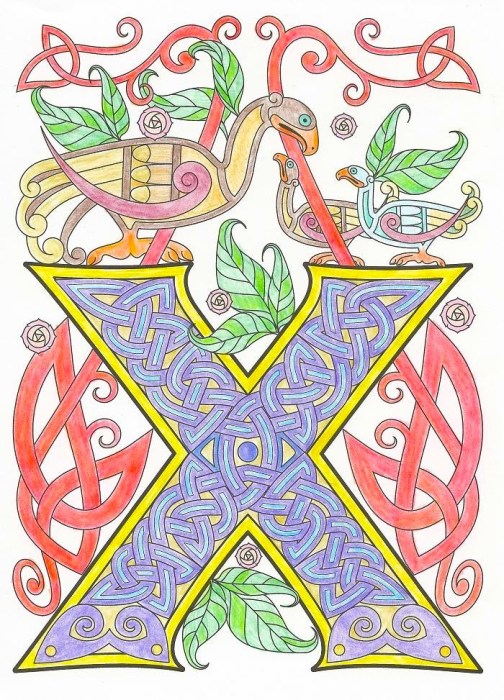
Xiwangmu (Chinese)
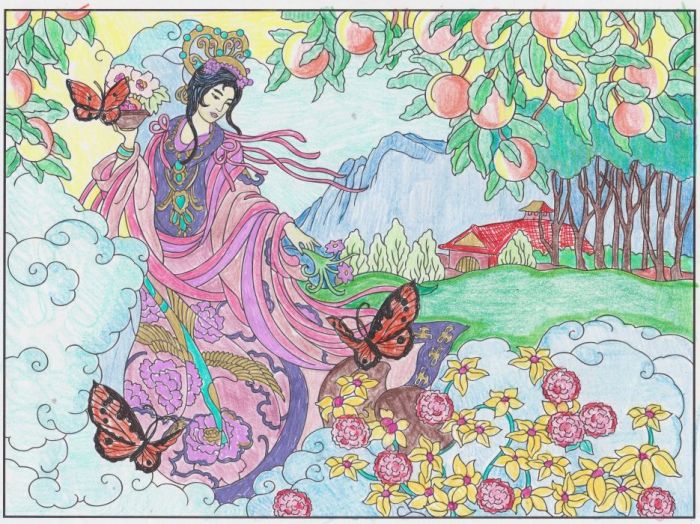
Xiwangmu, aka Queen Mother of the West
The first historical information on Xiwangmu can be traced back to Shang dynasty oracle bone inscriptions that record sacrifices to a “Western Mother.” Even though these inscriptions illustrate that she predates organized Taoism, she is most often associated with Taoism. The growing popularity of the Queen Mother of the West, as well as the beliefs that she was the dispenser of prosperity, longevity, and eternal bliss, took place during Han dynasty, in the 2nd century BCE, when the northern and western parts of China became more accessible through the opening of the Silk Road.
Her Names and Cultures
Queen Mother of the West is a calque – where calque is defined as a word or phrase borrowed from another language so as to create a new word or phrase — of Xiwangmu in Chinese sources, Seiōbo in Japan, Seowangmo in Korea, and Tây Vương Mẫu in Vietnam. She has numerous titles, one being Yaochi Jinmu (瑤池金母), the “Golden Mother of the Jade Pond (also translated “Turquoise Pond”.) She is also known in contemporary sources as the Lady Queen Mother.
In Chinese salvationist religions, she is believed to be the same being as their main deity, Wusheng Laomu (Chinese: 無生老母; lit. ‘birthless old mother’), also known as Wujimu (無極母; lit. ’infinite mother’.) The title, Wujimu, signifies the absolute principle of reality, or the creational origin of all things.
Tang writers called her “Golden Mother the First Ruler,” the “Golden Mother of Tortoise Mountain,” “She of the Nine Numina and the Grand Marvel,” and the “Perfected Marvel of the Western Florescence and Ultimate Worthy of the Cavernous Darkness.” Commoners and poets of the era referred to her more simply as the “Queen Mother,” the “Divine Mother,” or simply “Nanny” (Amah.)
Flourishing parasols, we reach the chronograms’ extremity;
Riding on the mist, I wander to Lofty Whirlwind Peak.
The Lady of the Supreme Primordial descends through jade interior doors;
The Queen Mother opens her Blue-gem Palace.
Celestial people—What a Crowd!
A lofty meeting inside the Cyan Audience Hall.
Arrayed Attendants perform Cloud Songs;
Realized intonations fill the Grand Empty Space.
Every thousand years, her purple crabapple ripens;
Every four kalpas, her numinous melon produces abundantly.
This music differs from that at the feast in the wilderness—
So convivial, and certainly infinite.
— Wu Yun (Complete Tang Poems 1967, line 4942)
 Xiwangmu in the celestial court,
from the murals of Yongle Temple, Yuan dynasty
The Queen Mother of the West is most often depicted holding court within her palace on the mythological Mount Kunlun, usually supposed to be in western China (a modern Mount Kunlun is named after this.) Her palace is believed to be a perfect and complete paradise, where it was used as a meeting place for the deities and a cosmic pillar where communications between deities and humans were possible. At her palace she was surrounded by a female retinue of prominent goddesses and spiritual attendants. One of her symbols is the Big Dipper.
In China, The Queen Mother of the West is Xiwangmu (aka Hsi Wang Mu.) In Daoist mythology, queen of the immortals in charge of female genies (spirits) who dwell in a fairyland called Xihua (“West Flower”). Her popularity has obscured Mugong, her counterpart and husband, a prince who watches over males in Donghua (“East Flower”) paradise. Tradition describes the queen as a former mountain spirit transformed into a beautiful woman from a quasi-human with a leopard’s tail and tiger’s teeth. Her fairyland garden was filled with rare flowers, extraordinary birds, and the flat peach (pantao) of immortality.
A Daoist romance relates that during a visit to Wudi, emperor of the Han dynasty, Xiwangmu gave him the famous peach of immortality. He was anxious to bury the stone, but Xiwangmu discouraged him by saying that Chinese soil was not suitable and, in any case, the tree bloomed only once in 3,000 years.
The Hongwu emperor, who was the first Ming emperor (1368–98,) was presented with a pantao stone discovered in a treasure house of the previous (Yuan) dynasty. Ten engraved ideographs identified the stone as that given to Wudi by Xiwangmu.
According to Daoist myth, Xiwangmu’s birthday is celebrated by the Baxian (“Eight Immortals”) with a grand banquet during which Xiwangmu serves special delicacies: bear paws, monkey lips, and dragon liver. Pantao are offered as the last course, the peaches that imbue the guest with immortality when eaten.
Daoist Literature
One of the earliest written references to the Queen Mother comes from the writings of the Taoist writer Zhuangzi (c. 4th century BCE):
The Queen Mother of the West obtained it [the Dao]… …and took up her seat at Shao kuang. No one knows her beginning; no one knows her end.
Zhuangzi describes the Queen Mother as one of the highest of the deities, meaning she had gained immortality and celestial powers. Zhuangzi also states that Xiwangmu is seated upon a spiritual western mountain range, suggesting she is connected to not only the heavens, but also to the west.
Tu Kuang-ting’s textual account, the Queen Mother plays the role of Laozi’s superior and is credited with the ultimate authorship of the Dao De Jing. This dichotomy of the Queen Mother as the superior is a characteristic of Shangqing Taoism, a goddess worshiping sect of Taoism of which Tu Kuang-ting was a master. There is also an account of a meeting between the Queen Mother and Laozi in Tang poetry. This account however, being of traditional Taoist thought, has the Queen Mother taking an inferior role to Laozi, calling him “Primordial Lord” (the title of his highest manifestation) and pays homage to the sage.
Xiwangmu’s Relationship with Women
Because she was the highest goddess of the Taoist religion and ruler of female Transcendents, Xiwangmu was seen to have had a special relationship with all women. She was said to care for all woman Daoists in the universe, both perfected and aspirants. Tang writers frequently refer to her in poems about Daoist women. She appears as teacher, judge, registrar, and Guardian of female believers. Perhaps most importantly, she was held in especially high regard by Chinese women who did not represent the societal norm of the submissive woman. To these women, Xiwangmu was seen as “a powerful, independent deity representing the ultimate yin controlling immortality and the afterlife.”
In Popular Culture
— Lake Heihai in the Kunlun Mountains has been associated with the Jade Pond of the Queen Mother of the West and a temple has been erected in her honor on its shore.
–“Si Wang-mu”, named after the goddess, is a character in Orson Scott Card’s Xenocide and Children of the Mind.
–Xiwangmu is a character in Carrie Vaughn’s Kitty’s Big Trouble.
–Xiwangmu appears in several of the Shin Megami Tensei games. Her latest appearance was in Shin Megami Tensei IV.
–Xiwangmu is the name of a city on the planet T’ien Shan based on oriental religions in the book The Rise of Endymion by Dan Simmons, part of the Hyperion Cantos series. The planet is mountainous and therefore likely named after Tian Shan.
–Xiwangmu appears as one of the heroes of Emperor: Rise of the Middle Kingdom: in the game, she boosts monument construction and can capture animals on the map.
–Part Four of Amy Tan’s The Joy Luck Club is titled “Queen Mother of the Western Skies.” In its prologue, a grandmother addresses her infant granddaughter, teasingly suggesting the child is the reincarnation of the Queen Mother of the West, come to share the secret of eternal happiness.
–The Fountain by Darren Aronofsky contains symbols similar to those of Xiwangmu.
–In 2004 Hong Kong drama, My Date with a Vampire III Yaochi Shengmu is one of the antagonist from the Pangu clan.
–In The Grave Robbers’ Chronicles volume six, the Graveyard of a Queen refers to Xiwangmu’s.
–In the 2022 mobile game Dislyte, Jin Yuyao is a Legendary Esper with the powers of Queen Mother.
–In The League of Extraordinary Gentlemen: Black Dossier, Orlando was an intimate acquaintance of hers, she was later usurped by a reincarnate of Ayesha.
–In the 2021 mobile game Mythic Heroes, the Western Queen in an SSR Luminarch support hero
–In mobile game Journey Renewed: Fate Fantasy, the event The Ancient Kunlun features the Queen Mother of the West as a new SSR Stellar Character.
Question: If you were a goddess
what would your criteria be
to imbue immortality?
Sources:
Brittanica
wikipedia


Librarian Lore (by Erin Penn) – Publication, of course.
LikeLiked by 1 person
:)
LikeLike
Having a mother and being a mother, I think this is my favorite of your posts this month. How nice that her name starts with X!
LikeLiked by 1 person
Karen, I’m glad you like Xiwangmu. She’s got a lot going for her.
LikeLike
I love all the beautiful names of this goddess.
I have no desire to have or give immortality–at least not in the same human form. We are all immortal since our elements will decompose and recombine to become something new. Why should we want more than that? That’s why I think everything has a consciousness of some kind. (K)
LikeLiked by 1 person
I agree with your idea of immortality via being endlessly recycled. I find it hard to believe our consciousness doesn’t just fall into non-being once we die. Xiwangmu is a beautiful being whoever or whatever she was or is.
LikeLiked by 1 person
That’s a ton of references in pop culture.
Tony (Danab Cycle)
LikeLiked by 1 person
Tony, I think Xiwangmu is still very much alive in China.
LikeLike
Fascinating post, Lisa, and I love the art that you used for the lettering of the post. I think if immortality was a real thing, it would make people arrogant and uncaring, so I would think that kindness should be a character trait I would like to imbue an immortal. Linzé
LikeLiked by 1 person
Thanks, Linze’, Cari Buzak has illustrated several coloring books. You can find them at Dover Books. I like your rationale for imbuing immortals with.
LikeLiked by 1 person
I will definitely have a look, thanks Lisa.
LikeLiked by 1 person
You’re welcome.
LikeLike
She’s an interesting goddess! 🥰🥰
LikeLike