
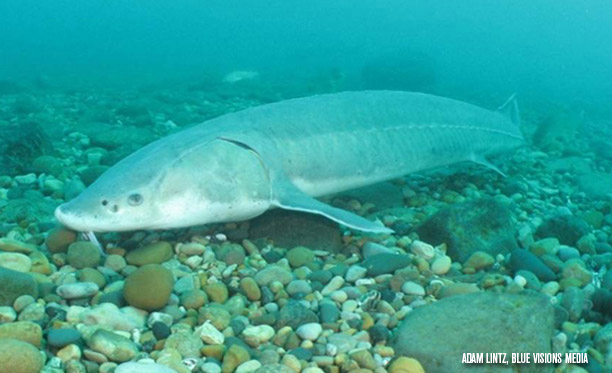
Lake sturgeon are a long‐lived species. They are the only sturgeon species endemic to the Great Lakes Basin and are the largest freshwater fish indigenous to this system. Lake sturgeon spawn in their natal rivers and prefer rocky areas in freshwater tributaries, usually along the outside bend of rivers as suitable spawning habitat.
These huge fish can measure six and a half feet (two meters) long and weigh close to 200 pounds (90 kilograms). Instead of scales, the lake sturgeon has coarse skin.
Despite their name, lake sturgeon are found in rivers as well as lakes. The fish’s range spans North America from the Hudson Bay to Mississippi River. This fish was once an abundant species in the ecosystems of the Great Lakes, but over harvesting has decreased its numbers.
Lake sturgeon feed along lake bottoms on small invertebrates, such as crayfish, snails, claims, and leeches.
Lake sturgeon migrate to shores of freshwater lakes in early summer for spawning. Female lay anywhere from two to three million eggs per season. Sturgeon may not begin spawning until they are 15 to 25 years old, and only spawn every four years on average.
These fish can live for decades. Males may reach 55 years, while females have been recorded living for 150 years.
Sturgeon can be seen porpoising—or jumping in the air—after entering a spawning stream.
Their evolution dates back to the Triassic period some 245 to 208 million years ago. Almost all species are highly threatened or vulnerable to extinction due to a combination of habitat destruction, overfishing, and pollution.
Kun rise clear water
Absent bends, blind poisons, spears,
Queen’s final winter.
I look at the lake sturgeon as the Kun fish, the ones that morph into dragons in Chinese mythology. What will happen to us when dragons no longer rise to the sky?
data from National Wildlife Federation website and wikipedia
Amaya is today’s host of dVerse. Amaya says:
Write a poem in whichever form you see fit to do justice to your version of “majestic.”


Such a wonderful fish… will humankind be the one that ends their reign of the rivers?
LikeLiked by 1 person
Like the trees, when the sturgeon go, we go.
LikeLike
So interesting Lisa! I really enjoyed that 🙂💕
LikeLiked by 1 person
Thank you, Christine, glad you enjoyed learning about these majestic fish.
LikeLike
Caviar comes from sturgeon.
LikeLiked by 1 person
As far as I know, any fish egg can be considered caviar. There needs to be a moratorium on all sturgeon.
LikeLiked by 2 people
I love all the facts you presented and then, you mentioned the dragons of old. Wonderful juxtaposition. the sturgeon of the great lakes is a magnificent beast for sure.
LikeLiked by 1 person
Thank you, Toni :)
LikeLike
We have sturgeon in the Columbia River. My grandfather fished for them in 1915, and they were plentiful. Today it is rare to sight one, or catch one. One of the reasons i/s the five huge dams n the river.
LikeLiked by 1 person
Man’s pathological compulsion to f*ck with Mother Nature, those dams. I was watching a Colbert Report segment talking about what terrible shape the nations dams are in. I hope they all crumble to dust.
LikeLike
Enjoyed.
I once had a six-foot sturgeon swim along side me as I drifted on the bottom of the Niagara River. It was a bit disconcerting to see a shadow on my right when I knew my dive buddy was attached to a line on my left.
LikeLiked by 1 person
Oh my that would be a bit nerve-wracking. That is truly amazing at the same time, Ken, to swim along side a sturgeon!
LikeLiked by 1 person
May we let them survive. Well described. A majestic fish.
LikeLiked by 1 person
Yes, Frank, thank you, and yes.
LikeLiked by 1 person
Interesting and sad to see humanity’s influence on these fish. Your words do them justice.
LikeLiked by 1 person
Yes, it’s a tragedy in the making. Thank you, Barry.
LikeLike
I like your image of a dragon fish. Our world and it’s stories become poorer with each species’ disappearance. (K)
LikeLiked by 1 person
:( yes
LikeLiked by 1 person
Wow, that is a long life span for females…if they get the chance that is…
LikeLiked by 1 person
didn’t know about this majestic huge fish, thanks for sharing your knowledge :)
LikeLiked by 1 person
You are very welcome. Efforts are being made to reintroduce them to rivers they’ve disappeared from, but with the other stressors it may not make a difference to their survival :(
LikeLiked by 1 person
so said when we kill off a species …
LikeLiked by 1 person
Very interesting info on these fish. Thanks for sharing.
LikeLiked by 1 person
Thank you, Sadje!
LikeLiked by 1 person
You’re welcome Li.
LikeLiked by 1 person
It is a worthwhile question you pose: what will happen to us, or to anything really, when our choices reflect short-term profit or comfort over biodiversity and stewardship? Thank you for highlighting this majestic creature.
LikeLiked by 1 person
You’re very welcome, Amaya.
LikeLike
Wow, that is cetrainly majestic. I love the idea of the Kun fish – perhaps we should remember them as we pollute and destroy our waters. They will exact revenge…
LikeLiked by 1 person
Thank you, Sarah.
LikeLike
Well let’s hope the dragons always continue to rise. A very informative post, we need to keep our waterways clean for the majestic creatures that reside below.
LikeLiked by 1 person
Yes, Truedessa. Everything is connected on on Mother Earth…
LikeLike