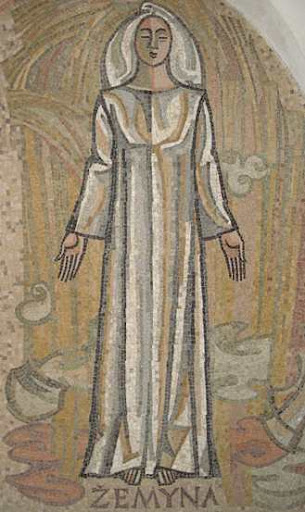
Žemyna (Lithuanian)

Žemyna
Other names known by:
Žemlja
Perkunatelé
Žemynėlė or Žemelė) (from Lithuanian: žemė – earth/)
Žemyna stems from the name of Proto-Indo-European Earth-goddess *Dʰéǵʰōm, which relates to Thracian Žemele (‘mother earth’) and Greek Semelē (Σεμέλη.)
Žemyna is the earth-goddess and is a psychopomp of the dead. She is usually regarded as mother goddess and one of the chief Lithuanian gods similar to Latvian Žemes māte. She personifies the fertile earth and nourishes all life on earth, human, plant, and animal. While she was connected to the fertility of the land, she was also associated with receiving the dead and acting as their ruler and guardian. Pieces of Lithuanian folklore also make references to Earth as mother of humans and their final abode after death.
Archeological findings witness that the most ancient phase of Lithuanian culture was definitely Žemyna’s culture. The distinguishing factor in these findings was the burial rites. In the oldest cultural phase, the dead were buried – given back to Žemyna, Mother Earth.
Lithuanian ethnologue Nijolė Laurinkienė says:
Žemyna was also imagined as the giver and supporter of human life, because like flora and fauna, humanity is a part of nature. (…) The newborn would immediately be laid down on Mother Earth as if she were its biological mother, so that she could ‘accept’ and ‘embrace’ the infant as her own earthly creation and give it vegetative power and vitality on a cosmic plane…
Family
The goddess is said to be married to either Perkūnas (thunder god) or Praamžius (manifestation of chief heavenly god Dievas.) Thus the couple formed the typical Indo-European pair of mother-earth and father-sky. It was believed that the earth needs to be fertilized by the heavens (rain and thunder.) Thus it was prohibited to plow or sow before the first thunder as the earth would be barren.
Textual Mentions and Rituals
Žemyna was first mentioned in texts in 1582 and was later also described by scholars in 1595, 1653, 1740, and in numerous folk legends, beliefs, and prayers. One scholar described a ritual, called žemyneliauti, performed at major celebrations or agricultural works, where the head of the household would drink a cup of beer, but first, he would spill some of the drink on the ground and say a short prayer. Then he would kill a rooster or a hen, which would be cooked and eaten by the entire family. Each family member would receive a loaf of bread and say prayers, blessings, and greetings. The bones and other scraps would be sacrificed to the goddess (burned or buried.) Other recorded rites included burying bread baked from last crops of prior harvest in a field before new sowing and sacrifice of a black piglet. People would also kiss the earth saying a short prayer thanking Žemyna for all her gifts and acknowledging that one day they will return to her. People addressed Žemyna in various affectionate diminutive names and epithets.
What Are the Symbols of Žemyna?
Žemyna is symbolized through sacred elements that reflect her divine status, embodying ancient symbolism revered in the worship of goddesses and deities.
In ancient cultures, Žemyna’s connection to the earth and fertility was often represented through symbols like the cornucopia overflowing with abundance and the blooming flower signifying growth and renewal. These symbols emphasized her role as a nurturer and provider, embodying the cycles of life and nature.
The sacred tree was a prominent motif associated with Žemyna, representing strength, wisdom, and connection to the spiritual realm. Such symbolic representations underscored the reverence and adoration bestowed upon Žemyna in the realms of worship and divinity.
In Modern Times
The Lithuanian folk music group Kūlgrinda in collaboration with Donis released an album in 2013 titled Giesmės Žemynai, meaning “Hymns to Žemyna.”
Throughout Lithuania, various festivals and rituals are dedicated to Žemyna, celebrating her role as the goddess of the earth and fertility. One of the most notable celebrations is the Užgavėnės festival, which marks the end of winter and the beginning of spring. During this time, people engage in various activities, such as feasting, dancing, and performing traditional songs. These celebrations are not only a way to welcome the warmer months but also an opportunity to honor Žemyna and seek her blessings for the upcoming agricultural season.
Question: if you could ask
your favorite goddess anything,
what would you ask?
Sources:
wikipedia
World Mythos
Legendary Ladies Hub
Here we are, at the end of another A2Z. I have enjoyed writing up each of the 26 posts on Goddesses from All Times and Places. I hope I have succeeded in getting you to think about your inner (and outer) goddess. I appreciated reading each and every response to my questions. I’d like to do another post that compiles the goddess attributes and the responses to the questions.
Here are links to each one:
Amaterasu (Japan)
Bast (Egypt)
Chalchiuhtlicue (Aztec)
Diana (Rome)
Eos (Greece)
Freya (Nordic/Teutonic)
Gleti (Dahomey)
Hastseoltoi (Navajo)
Inanna (Sumeria)
Jiang Yuan (China)
Konohana (Japan)
Lakshmi (Hindu)
Mahu/Mawu (West Africa)
Nut (Egypt)
Oshun (West Africa)
Pachamama (Peru)
Qin Liangyu (China)
Rhiannon (Wales)
Spider Woman (Navajo)
Tara (India)
Urania (Muse)
Vanth (Etruscan)
White Buffalo Calf Woman (Lakota/Sioux)
Xiwangmu (China)
Yushkep (Ainu)
Žemyna (Lithuania)
Since I’m going on hiatus starting May 1, I won’t be around for the afterword on A2Z. I wish I didn’t feel compelled to say that some of the ~30 blogs I’ve visited pretty much every day for the month got no other likes besides me or very few. It has got to be disappointing for those individuals who put so much time into their 26 posts.
OK, now I’d like to give a list of my favorite A2Z’ers this year:
J. R. Vincente’s Erotic Fiction Blog J’s continuing erotic story that gets sizzling by the end.
Sue’s Trifles shares her fun homophone list and challenges us to find more.
Brizzy Mays Books And Bruschetta May visits small towns with character in Australia.
Black and White (Words and Pictures)Anne shares her block prints and refashioned fairytales.
Time and Tide Pradeep shares places in India known for unusual customs, practices, and mysterious phenomena.
Postcards Etc. Marina shares postcards of Important Women and includes their image and a quote by them.
Kaye Spencer, romance author Kaye shares songs that have cars and/or car-related items in the lyrics.
Light Motifs Paula Light (from WP before) shares her memoirs with neat pictures.
Coming Down the Mountain Karen, an Ex-Pat in Mexico and further south, shares insider info on travel and particular places.
Danab Cycle Tony shares conversations between extraterrestrials and humans.
Very Important Stuff Here Tired Hamster shares Darren’s (Everyman’s) trials and tribulations.
Part-time working Hockey Mom Tamara from Switzerland goes back to the 1980’s.
J-Dubs Grin and Bear It Jill shares a great playlist of songs.
The SkyGirl Musings Esha goes step by step with meditating. Very relaxing to read.
Butterfly on a Broomstick Linze’ shows mixed media art she has created.
The Confusing Middle Aaron gives us alternate Earths. Brave New Worlds! Great series.
The Page Turns Kaj talks about small countries, their geography, and their histories.
Erin Penn’s Second Base Erin shows up with just about anything – and it’s just right.
By Sarah Sarah shares lovely photography and poetry.
Thoughts of a Wanderer Brenda shares a plethora of pretty pictures of places and things.
Sharon E. Cathcart Sharon gives the nitty-gritty of insider info on live theater production.
Welcome to My Magick Theatre Carrie-Anne shares delicious Iranian recipes.
Its PH Prakash Hegade shares excellent terms on mind and its biases.
Hot Dogs and Marmalade Sally shows old photos and asks us to finish limericks with her.
Janet’s Smiles Janet shares political opinions that lean to the left.
Tell Me Another Josna shares insightful reflections on history, personal and political.
A Unique Title for Me Jim Adams was not on the official list of participants but he did a very detailed A2Z on the intricacies of golf. I read at least some of most of his posts. Golfers should take a look at it or those interested in learning how to play and/or play better.
 Tao-Talk
I enjoyed learning about all the goddesses from you Lisa.
LikeLiked by 1 person
Awesome, Jim. Thank you. I had a good time getting back to coloring again and trying to distill info from what I found into a decent synopsis. I also learned a lot about golf that I never knew from you.
LikeLiked by 1 person
Fascinating, Li. And the index at the end is helpful for reviewing and/or writing inspiration. 🙂
LikeLiked by 1 person
Thank you, Dora <3
LikeLiked by 1 person
If I could ask my Librarian anything? To live long enough to finish my TBR pile…while being allowed to add things to the TBR as I discover them. Oh, and I need to keep my eyesight and be healthy enough to read and enjoy the pile. Happy Zed day and thank you for the mention. Enjoy your break, you deserve it. I’m collecting the Librarian comments for my “L is for Librarian Lore” in next year’s A-to-Z.
LikeLiked by 1 person
Erin, that is a very good ask of your Librarian. You will be immortal and enriched along the way. Very neat idea to collect your comments for next year’s A2Z! I very much enjoyed yours this year.
LikeLike
Wow, thank you for including my on your list. I’ve sure enjoyed your posts this month and appreciate your visits and comments on my blog. Zemyna makes a really nice girl’s name. I didn’t realize it until I said it out loud trying to figure out how to say it.
LikeLiked by 1 person
You’re most welcome. Thanks much, Karen.
LikeLike
This was my favorite entry. Congratulations on finishing! And, clearly, for visiting so many blogs! Including mine. Your comments were appreciated.
Tony (Danab Cycle)
LikeLiked by 1 person
Tony, thanks so much. I’ll still be reading everybody’s last entries but later tonight.
LikeLike
Congrats on finishing the A2Z! I’ve really enjoyed following your goddess series—Žemyna is such a cool, grounded way to wrap things up.
I’m actually reading this while hovering in the kitchen, waiting for the carpet cleaners to finish up the living room. Since Žemyna is all about the earth and home, I’m hoping she blesses these floors to stay clean for more than five minutes! Enjoy your well-deserved hiatus!
LikeLiked by 1 person
Thank you, Maria, and I agree about Zemyna being a good finisher.
LikeLike
Another one of my favorites. I especially like that top sculpture.
As to what I would ask for I can’t say it any better than George.
LikeLiked by 1 person
Kerfe, I love it. Sending love your way, my friend. Cheers!
LikeLiked by 1 person
💜
LikeLike
You did a terrific job Li 🥰🥰 I totally enjoyed the posts!
LikeLike
Lisa, this has been such a fascinating and beautifully researched series from A to Z. I’ve loved traveling through so many cultures and myths with you, and Žemyna was a wonderful way to close it out.
Thank you also for the kind mention; I’m honored to be included among your favorite A-Z blogs this year. Wishing you a restful and inspiring hiatus.
LikeLike
Thank you for including me in your list of A to Z blogs you enjoyed, Lisa. Much appreciated. Sue from Sue’s Trifles.
LikeLike